
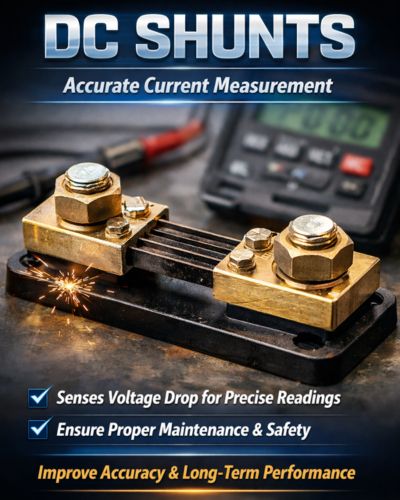
Measurement of current in electrical circuits is crucial to the performance of a system, safety, and efficiency. Technicians and engineers tend to use devices such as resistors and DC shunts to measure current. Although both have the same basic purpose, knowledge of the benefits of DC shunts as opposed to resistors can be used to maximize performance with regard to industrial, commercial, and consumer applications.
DC shunts are special purpose devices that are used specifically to measure current whereas resistors are general purpose components that may also be used to detect current. Selecting the appropriate tool ensures reliability, accuracy, and energy efficiency.
What is a DC Shunt?
A DC shunt is a precision element and a low-resistance device used to measure current by developing an equivalent voltage drop across it. This voltage drop is measured to establish the amount of current passing through the circuit.
How DC Shunts Work
- A small voltage drop is created as current passes through the shunt.
- The voltage is proportional to the current according to Ohm’s Law, V = I × R.
- A voltmeter or a data acquisition system measures the voltage from which the current is calculated.
Common Applications
- Power monitoring in industries.
- Battery management systems (BMS).
- Electric vehicles.
- Renewable energy systems
What is a Resistor in Current Measurement?
Current sensing is commonly accomplished through the use of resistors in the form of a voltage drop across them. Resistors are inexpensive and easy to use, but they are not accurate enough for high-accuracy tasks.
Limitations of Resistors in Current Measurement
- Increased resistance values may cause a large amount of power loss.
- Less accurate with high-current circuits.
- Prone to temperature variations that influence accuracy.
Typical Use Cases
- Inexpensive electronic circuits.
- Simple overcurrent protection in non-critical installations.
Key Advantages of DC Shunts Over Resistors
DC shunts are commonly employed in current measurements as they provide significantly more accurate measurements as well as better performance compared to standard resistors, particularly in challenging electrical environments.
Higher Accuracy in Current Measurement
DC shunts are produced with a high degree of tolerance, providing very accurate readings. As opposed to conventional resistors, shunts reduce error in the measurement, hence they are best used where accuracy is of high importance.
Comparison:
- DC shunts: ±0.1% to ±0.5% accuracy
- Standard resistors: ±1% to ±5% accuracy
Reduced Power Loss
Low-resistance DC shunts lead to a low voltage drop, minimizing wasted energy in the form of heat. Conversely, the resistors that have a higher value of resistance, can produce a lot of heat and reduce the efficiency of the entire system.
Better Heat Management
Shunts are designed to transfer large currents without overheating, thus increasing the duration of operation. They can be made from materials that have good heat dissipation, unlike conventional resistors.
Wide Range of Current Handling
DC shunts are available in very low to extremely high currents,making them flexible for industrial, commercial, and automotive systems.
Enhanced Safety and Reliability
Shunts are stable under changing currents, and circuit damage as well as component failures are minimized. This renders them very dependable in critical applications such as electric vehicles and power distribution systems.
Applications of DC Shunts
DC shunts are typically applied in most electrical systems in which safe and more precise current measurements are needed on a continuous basis.
- Industrial Current Measurement: Monitor motors, generators, and industrial equipment efficiently.
- Power Supply Monitoring: Ensure stable voltage and current in commercial power systems.
- Electric Vehicle and Battery Management Systems: Accurately track battery charge and discharge cycles.
- Comparison with Resistors: Shunts are preferred for precision tasks, while resistors are suitable for low-cost, less critical applications.
Conclusion
They are essential in providing correct and consistent current measurement due to the benefits of DC shunts compared to resistors. They have a high level of precision, less power loss, better heat management and safety that make them better than standard resistors in professional use. In the case of businesses that are interested in reliable current monitoring solutions, DC shunts are the optimal choice to guarantee their improved functionality and extended equipment service life.
LeedyTech suggests DC shunts for all industrial and automotive current requirements to attain efficiency, performance and dependability.
FAQs
Q1: Can a resistor replace a DC shunt for accurate measurements?
While possible in low-accuracy scenarios, resistors cannot match the precision and reliability of DC shunts in high-current or critical systems.
Q2: How does a DC shunt minimize power loss?
DC shunts have very low resistance, so the voltage drop across them is minimal, reducing energy wasted as heat.
Q3: Where are DC shunts commonly used?
They are widely used in industrial equipment, battery management systems, electric vehicles, and power supply monitoring.
Q4: What is the lifespan difference between DC shunts and resistors?
Shunts are designed for high-current handling and better heat dissipation, resulting in a longer operational lifespan compared to standard resistors.