
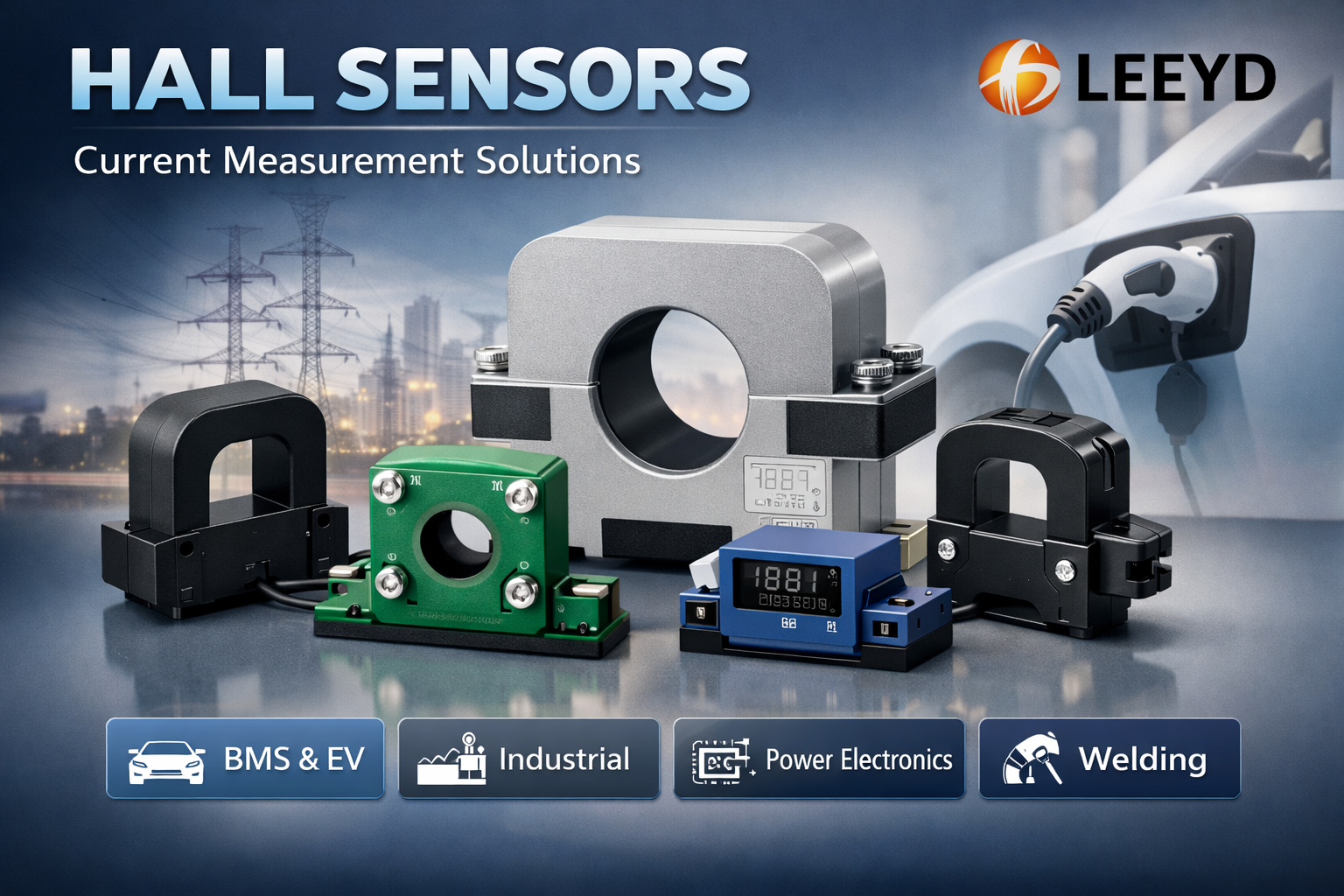
The benefits of Hall sensors have resulted in them being a favorite in the real-life systems of sensing and position detection in the electronic world. With the shift of industries toward automation, precision, as well as reliability, non-contact technologies are being adopted in place of traditional mechanical sensors.
Hall sensors are a contemporary, non-contact method to detect magnetic fields, current flow, speed, and position. They are used in modern automotive, industrial, and consumer electronics owing to their capability to provide precise, steady and repeatable measurements without physical degradation.
What is a Hall Sensor?
A Hall sensor is an electronic device whose operation is based on the Hall effect which is a phenomenon discovered by Edwin Hall. When the current carrying conductor is exposed to a magnetic field, the magnetic field induces a voltage at right angles to the current and the field.
Key Characteristics of Hall Sensors
Hall sensors are known for their reliability, accuracy, and ability to operate without physical contact:
- Detect magnetic fields without physical contact
- Convert magnetic variations into electrical signals
- Provide consistent and reliable outputs
Types of Hall Sensors
Hall sensors are available in various types, each designed to meet specific sensing and application needs
- Digital Hall Sensors – Output ON/OFF signals (used as switches)
- Analog Hall Sensors – Provide continuous voltage output
- Linear Hall Sensors – Measure field strength proportionally
- Hall Switches – Detect magnetic presence or absence
How Hall Sensors Work
Hall sensors function through non-contact magnetic sensing, eliminating the need for mechanical interaction. When exposed to a magnetic field, the sensor detects changes and produces a corresponding electrical signal.
Comparison with Traditional Sensors
Compared with mechanical or resistive sensors, Hall sensors:
- Do not suffer from friction or wear
- Maintain accuracy over long operating cycles
- Perform reliably in harsh environments
Common Use Cases
Hall sensors are widely used wherever precise detection of position, speed, or current is required:
- Current measurement in power systems
- Speed detection in motors and wheels
- Position sensing in industrial automation
Key Advantages of Hall Sensors
The main advantages of Hall sensors lie in their non-contact operation, durability, and consistent performance.
Non-Contact Operation
Hall sensors do not touch anything.Due to the lack of touching or rubbing, there is no wear on parts. This enables the sensor to be longer-lasting and require less repair.
High Accuracy and Precision
Hall sensors provide proper and consistent outputs.Friction and motion do not affect them. This makes them suitable for measuring speed, position, and electric current.
Wide Range of Measurement
Hall sensors have the ability to measure numerous things. They are able to sense electric current, magnetism and movement. This renders them applicable in automobiles, machines and electronics.
Fast Response Time
Hall sensors are fast reacting. They are able to transmit signals immediately.This is significant for robots, motors, and fast-working machines.
Compact and Easy Integration
Hall sensors are miniature and simple to install. They are easily fitted on the circuit boards. They are also compatible with various electronic systems.
Enhanced Safety and Durability
Hall sensors are robust and sturdy. They have the ability to work in dirty, damp or hot environments. This renders them industrial- and automotive-friendly.
Applications of Hall Sensors
Hall sensors are used across automotive, industrial, and consumer electronics industries for safe and accurate sensing.
Automotive Applications
Hall sensors are typically applied in cars.They assist in the measurement of wheel speed and throttle position and assist safety systems such as ABS and traction control. These sensors enhance driving safety and vehicle performance.
Industrial Applications
Hall sensors are applied in motor control and electric current measurement in industries. They also assist in detecting the position or presence of objects. This ensures a smooth and efficient operation of machines.
Consumer Electronics
Hall sensors are common in many devices in our daily life. They assist smartphones to read the screen orientation, enable keyboards to register key presses, and brushless motors in fans and home appliances.
Hall sensors are more reliable and have a longer service life compared to the other types, resistive, and mechanical sensors.
Conclusion
Hall sensors have superior performance compared to other conventional sensing technologies due to their benefits such as non-contact mode of operation, high precision, quick response and long life. Their reliability in harsh operating environments has made them a vital part of a modern electronic device and industrial system.
At LeedyTech,we suggest using Hall sensors in cases where required performance includes accuracy, durability, and security, to ensure future performance as the technological environment evolves.
Frequently Asked Questions
Q. What are Hall sensors mainly used for?
Hall sensors are used for current sensing, speed detection, and position measurement in automotive, industrial, and electronic systems.
Q. Are Hall sensors better than mechanical sensors?
Yes, Hall sensors are more durable, accurate, and maintenance-free due to their non-contact operation.
Q. Can Hall sensors measure current?
Yes, Hall sensors can accurately measure AC and DC current without direct electrical contact.
Q. Do Hall sensors wear out over time?
No, since they have no moving parts, Hall sensors experience minimal wear and offer long operational life.