
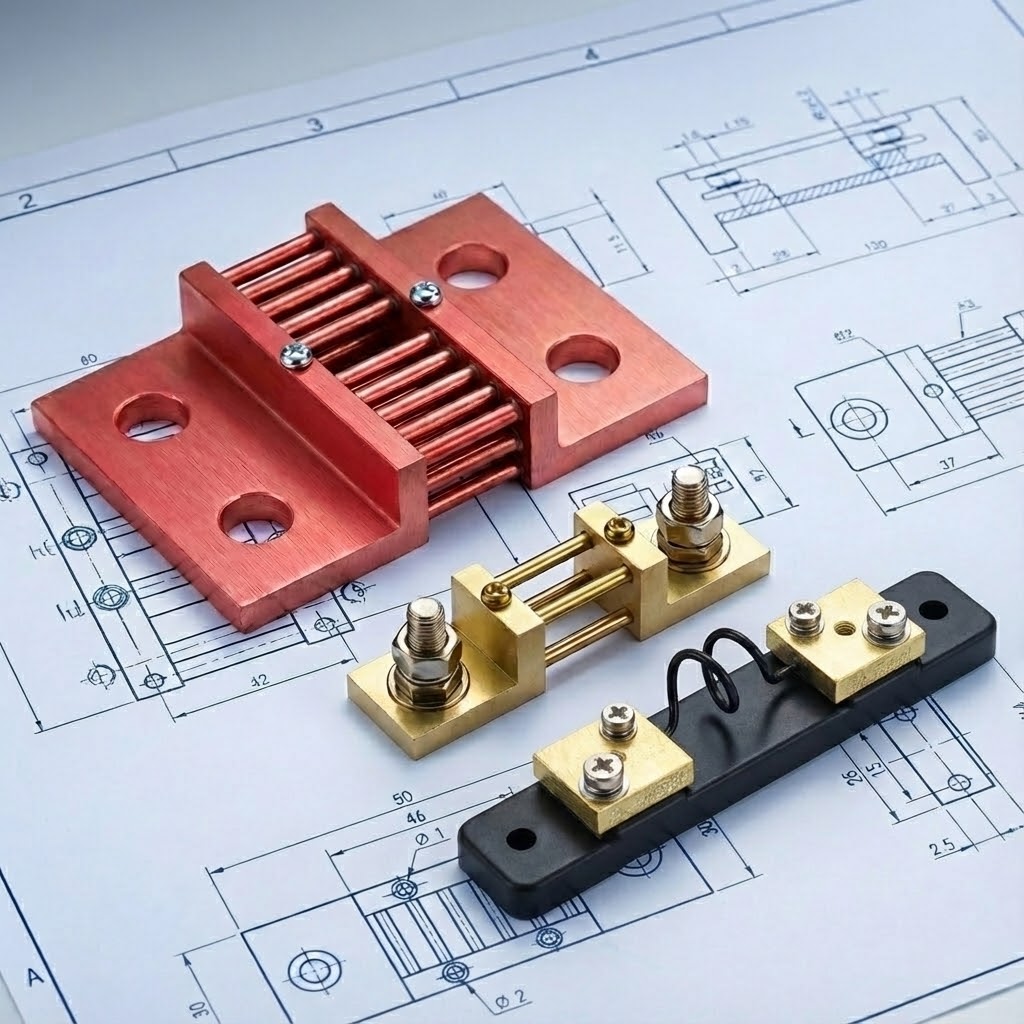
I have managed global power electronics supply chains for over 15 years. In that time, I have learned one hard truth: a $40 component can easily jeopardize a $100,000 power distribution system. Many procurement teams treat the dc current shunt as a simple commodity—a passive metal bar. This is a dangerous oversimplification.
I view the shunt as the “gatekeeper” of system intelligence. It translates massive, raw electrical force into the precise millivolt data that your control systems need to survive. If your shunt fails or drifts, your entire system “goes blind,” leading to thermal runaway or catastrophic equipment damage. We wrote this guide to move past the marketing fluff. We will focus on the technical logic, metallurgical integrity, and risk mitigation strategies required to choose a shunt that protects both your equipment and your bottom line.
1. Why Is the DC Shunt Critical for Grid Stability and System Intelligence?
Inaccurate power data creates a “blind spot” in your control logic. When a dc current shunt drifts, your inverter miscalculates the load, causing thermal stress or grid instability. I recommend high-precision shunts to provide the single source of truth for your monitoring software.
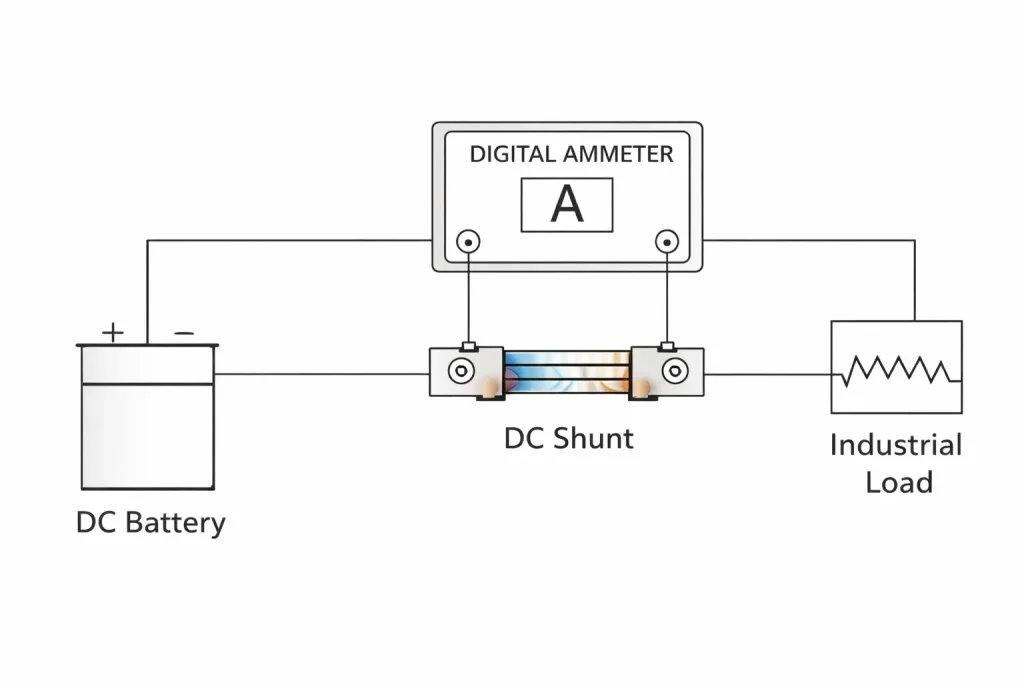
A DC current shunt is a high-stability, low-resistance resistor used to measure large currents. It produces a proportional millivolt (mV) drop as current flows through it, allowing meters and control systems to safely monitor high-amperage circuits without direct exposure to the main current path.
The Physics of High-Precision Millivolt Conversion
In my experience, the math behind a shunt is simple, but the execution is where most suppliers fail. We rely on Ohm’s Law:

In a B2B context, the R (resistance) must remain a constant. If you are measuring a 2,000A load using a 100mV shunt, the resistance is exactly 0.00005**Ω**. However, resistance is rarely a static number.
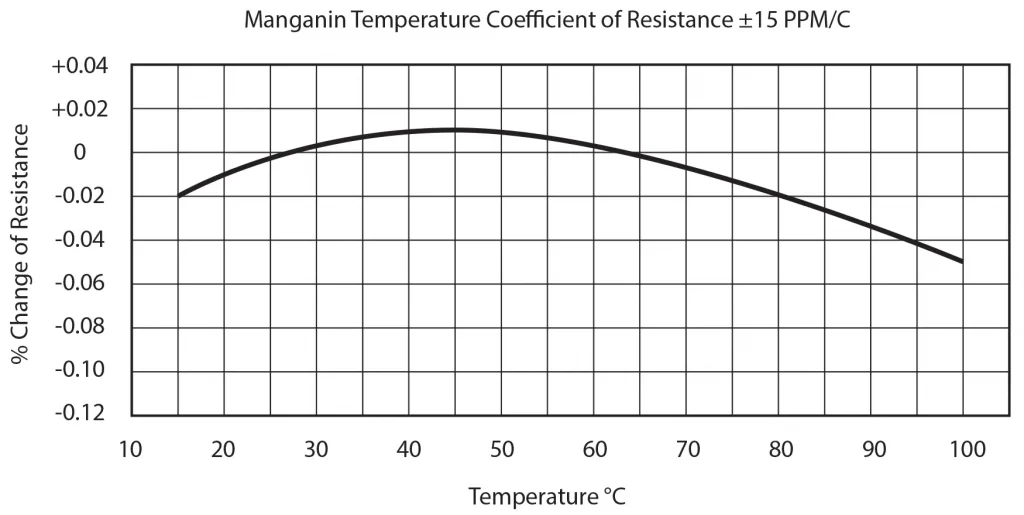
This is known as the temperature coefficient of resistance (TCR). If your R changes even by a fraction of a percent, your voltage output (V) no longer represents the true current (I). For a procurement manager, this means your 100mV signal might actually be reporting 98mV at high temperatures. In a megawatt-scale battery storage system, that 2% error represents a massive discrepancy in energy accounting and state-of-charge (SOC) calculation.
Why Modern Power Electronics Demand “Zero-Drift” Reliability
We are seeing a massive shift toward wide-bandgap semiconductors like SiC and GaN in modern inverters. These systems switch power at incredible speeds. They require “Zero-Drift” reliability because the control loops rely on instantaneous, accurate feedback to adjust timing. If the shunt reports a delayed or “drifting” signal, the inverter may over-compensate. I have seen this lead to “harmonic resonance” in grid-tied systems, where the power quality degrades until the utility provider forces a disconnect.
The Economic Impact of Measurement Inaccuracy
I often tell my clients that measurement inaccuracy is a hidden tax on your operations. In large-scale renewable projects, inaccuracy leads to two major financial risks:
- Revenue Loss: If you are under-reporting power generation due to shunt drift, you are literally giving away electricity for free.
- Safety Margin Overspending: If you don’t trust your sensors, your engineers will over-specify cables and breakers by 20% to 30% just to be safe. That is capital expenditure (CAPEX) that could have been avoided with a more accurate sensor.
| Signal Standard | Signal-to-Noise Ratio | Heat Generation | Typical Application |
| 50mV | Moderate | Low | Standard Industrial / Battery Monitoring |
| 75mV | High | Moderate | European Grid Standards / Power Plants |
| 100mV | Superior | High | High-Precision Lab / Aerospace |
Insider Insight: Many procurement teams treat shunts as “dumb” metal bars. In reality, the manganin-to-copper welding technique is the single most common point of failure. A microscopic void in the weld can lead to thermal runaway that destroys an entire $50k inverter. I always insist on ultrasonic weld inspection for my Tier 1 projects.
Is Material Integrity Your Best Risk Mitigation Strategy?
Temperature fluctuations cause cheap alloys to fail. This thermal stress forces your sensors to report erratic data. I prioritize high-grade Manganin because it ensures your readings remain true even when your equipment runs at maximum capacity.
Material integrity in a dc current shunt is defined by its resistance to thermal drift. Quality shunts use precision alloys like Manganin because they possess an extremely low Temperature Coefficient of Resistance (TCR). This property ensures that the shunt’s electrical resistance stays nearly constant as its physical temperature rises.
Manganin vs. Alternative Alloys: The TCR Factor
I have audited dozens of factories, and the biggest differentiator is always the alloy quality. Manganin is the industry standard for a reason. It is a mix of copper, manganese, and nickel. Its TCR is typically less than 10 parts per million per degree Celsius (ppm/°C). This means if the temperature rises by 50°C, the resistance only changes by 0.05%.
In contrast, some “budget” suppliers use Constantan or modified copper alloys. Constantan is cheaper but it has a high thermal EMF (Electromotive Force) against copper. When the junction between the Constantan resistor and the copper terminal gets hot, it creates a small voltage—like a thermocouple. This “ghost voltage” adds to your measurement signal. If you are measuring a low-current state, this error can represent 5% or more of your total reading. In a B2B setting, that error leads to “false trips” in your protection relays.
Corrosion Resistance in Harsh Industrial Environments
We often ship shunts to offshore wind farms or desert solar arrays. These are brutal environments. If the copper terminals of your shunt oxidize, the contact resistance increases. This creates a feedback loop of heat. The hotter it gets, the faster it oxidizes. Eventually, the heat melts the mounting base.
I look for shunts with thick nickel or tin plating. Many low-cost vendors use a “flash” plating process. This thin layer wears off within months of thermal cycling. I specify a minimum plating thickness of 5 microns for any outdoor or high-humidity application. This prevents the “green copper” corrosion that eventually kills your electrical conductivity.
Thermal Management and Baseplate Design
The physical structure of the shunt determines its lifespan. When current flows, the shunt generates heat. This heat must go somewhere. A well-designed baseplate acts as a heat sink. I prefer shunts mounted on high-temperature phenolic bases or specialized ceramics.
The mounting holes also play a role in safety. Copper and Manganin expand when they get hot. If the mounting is too rigid, the metal can warp or crack. I recommend “slotted” mounting holes. This allows the metal to expand and contract without putting mechanical stress on the bolts. If the bolts loosen due to stress, the connection becomes high-resistance, and you risk a fire.
| Material Property | Premium Manganin | Budget Constantan | Impact on Procurement |
| TCR (ppm/°C) | < 10 | 20 – 40 | Manganin stays accurate at 80°C. |
| Thermal EMF | < 1 µV/°C | > 40 µV/°C | Constantan creates “ghost signals.” |
| Stability | Excellent | Moderate | Manganin lasts 10+ years without drift. |
Insider Insight: Always demand a Resistance-Temperature Curve from your supplier. Tier 1 manufacturers optimize their manganin for a “flat” response at actual operating temperatures (usually 60°C–80°C), not just at the 25°C laboratory baseline. If a supplier only gives you data at room temperature, they are hiding the shunt’s real-world performance.
Accuracy Classes and Calibration: How Do You Avoid the “Paper Compliance” Trap?
Many buyers assume a certificate means every unit is perfect. But “typical” accuracy ratings often hide bad units that fail in the field. I demand individual testing for every dc current shunt to stop system failures before they start.
Accuracy classes define the maximum allowable error margin for a shunt. A 0.5% class shunt has a maximum error of 0.5% of its rated voltage drop at full current. These ratings help engineers choose the right precision for billing, battery management, and protection systems.
Decoding 0.1%, 0.25%, and 0.5% Accuracy Ratings
In my 15 years of consulting, I have seen that most people over-specify or under-specify their needs. You must match the accuracy to your goal. A 0.5% accuracy rating is the standard for general industrial monitoring. It is reliable and cost-effective. However, if you are working on a solar farm or a large battery storage site, you should move to 0.25%. This higher precision reduces the “uncertainty” in your energy calculations.
We only use 0.1% accuracy for laboratory equipment or high-end billing meters. Why? Because 0.1% shunts are very sensitive to mounting torque and wire placement. If your technician tightens a bolt too much, they can actually change the resistance of a 0.1% shunt. This makes them hard to use in the field. For most B2B applications, 0.25% is the “sweet spot” for reliability and performance.
The Importance of NIST-Traceable Calibration in B2B Contracts
If a component fails and causes a fire, the first thing the lawyers look at is the paper trail. NIST-traceable calibration means the factory tested your shunt against a “master” instrument that is verified by the National Institute of Standards and Technology. This is your legal protection.
But there is a trap here. Some suppliers use a “Batch Certificate.” This means they tested 1 unit out of 100 and gave the whole batch the same paper. I never accept this for mission-critical projects. You want a certificate that lists the specific serial number of the shunt you bought. This ensures that the unit in your hand was actually on the test bench.
Frequency of Re-calibration: Managing Long-term Maintenance Opex
Shunts do not stay the same forever. The metal “ages” as it heats up and cools down over thousands of cycles. This aging causes the resistance to drift slowly over time. If you do not plan for this, your system data will slowly become wrong.
I recommend a re-calibration cycle of every two years for industrial plants. For electric vehicle charging stations, you might check them every three years. You should include this in your long-term operating expense (Opex) budget. If you buy shunts that the factory “pre-aged” in an oven, the drift will be much smaller. This helps you save money on maintenance because the shunt stays accurate for a longer time.
| Accuracy Class | Max Error (mV on 50mV) | Industry Standard Use |
| 0.1% | 0.05 mV | Lab Testing / Revenue Grade |
| 0.25% | 0.125 mV | Solar / EV / Battery Storage |
| 0.5% | 0.25 mV | Motor Control / General Industry |
Insider Insight: “Batch Testing” is a red flag for high-precision projects. For mission-critical infrastructure, specify 100% individual serialized calibration reports to prevent “outlier” units from entering your assembly line. I have seen “batch-tested” shipments where 5% of the units were outside of the 0.5% tolerance. Individual testing is the only way to catch these outliers.
Is the Unit Price Hiding Your Real Supply Chain Costs?
Saving a few dollars on a component can cost you thousands in energy waste. This hidden overhead drains your project ROI over time. I focus on Total Cost of Ownership to protect your long-term margins.
The Total Cost of Ownership (TCO) for a dc current shunt includes the purchase price, energy waste through heat (watt-loss), installation labor, and downtime risks. Evaluating shunts based on energy efficiency and standardized mounting reduces long-term operational expenses and improves system reliability.
Energy Loss (I<sup>2</sup>R): Calculating the Price of Inefficiency
I always remind my clients that a shunt is a heater that you didn’t ask for. Because a shunt works by creating a voltage drop, it naturally consumes power. We calculate this loss using the formula P = I × V or P = I<sup>2</sup> × R. If you buy a cheap 2,000A shunt with a 100mV drop, that unit is dissipating 200 Watts of heat at full load.
If your system runs 24/7, that single shunt consumes 1,752 kWh of electricity per year. At an industrial rate of $0.12 per kWh, you are paying $210 every year just to power that one component. Over a 10-year lifespan, that is $2,100. If you choose a 50mV shunt instead, you cut that cost in half. Suddenly, the $10 difference in purchase price between two suppliers seems irrelevant. When you scale this across a solar farm with hundreds of shunts, the energy savings can reach six figures.
Installation Ergonomics and Labor Savings
Labor is the most expensive part of any US-based project. I have seen procurement teams buy shunts that do not match standard busbar dimensions. This forces the field crew to custom-drill copper or use expensive adapters. A “cheap” shunt that takes an extra hour to install is actually very expensive.
We look for shunts that follow NEMA or DIN mounting standards. This ensures the hole spacing matches your existing electrical hardware. I also check the terminal design. High-quality shunts feature massive copper blocks that help pull heat away from the measurement element. This “self-cooling” design allows you to use smaller cooling fans in your enclosures. This saves you money on your overall Bill of Materials (BOM).
Lead Time Volatility and Alloy Stockpiling
A $50 shunt can stop a $500,000 production line. The raw materials for high-grade shunts, like Nickel and Manganese, have volatile global prices. Many small manufacturers do not keep stock. They wait until they get your PO to buy the metal. This leads to 12-week lead times that can ruin your project schedule.
I prefer working with Tier 1 suppliers who maintain a strategic stockpile of specialized alloys. This allows them to ship standard parts in days, not months. In a B2B supply chain, “availability” is a form of insurance. You might pay 10% more for a supplier with local stock, but you eliminate the risk of late-delivery penalties from your own customers.
| Cost Factor | Impact of Low-Quality Shunt | Impact of High-Quality Shunt |
| Annual Energy Cost | High ($200+ per unit) | Low ($50 – $100 per unit) |
| Installation Time | 60+ Minutes (Custom fit) | 15 Minutes (Standard fit) |
| Replacement Cycle | 3-5 Years (Corrosion/Drift) | 10-15 Years (Stable) |
| Supply Chain Risk | High (12-week lead times) | Low (Stock available) |
Insider Insight: A cheaper shunt with higher resistance tolerance can cost 10x its purchase price in wasted electricity over a 10-year lifecycle. Shift the conversation from Unit Price to Watt-Loss Efficiency. I tell my procurement teams to treat the watt-loss as a “hidden lease payment” they will be stuck with for the next decade.
Can Your Supplier Actually Engineer a Solution?
Most “manufacturers” are just assembly shops. They cannot solve your design problems or analyze field failures. You need an engineering partner to protect your team from costly recalls.
A Tier 1 supplier for a dc current shunt provides in-house R&D, thermal imaging, and high-current validation. Look for advanced certifications like IATF 16949 and a documented “pre-aging” process to ensure the resistor remains stable over its entire operating life.
Evaluating R&D Infrastructure and Custom Capabilities
I have visited many factories that call themselves “manufacturers.” In reality, they are just cutting and bending metal. If your project requires a custom shape or a specific millivolt output, these shops will fail you. I always look for an engineering-first culture. Does the supplier have a thermal imaging lab? Do they use Finite Element Analysis (FEA) software to predict how heat will move through the metal?
A true partner can help you with “Thermal Simulation.” This is a computer model that shows where the hot spots will be in your cabinet. I have seen projects where a simple change in the shunt’s baseplate design lowered the cabinet temperature by $10^{\circ}\text{C}$. You cannot get that kind of help from a broker. You need a supplier with a high-current test bench that can run at $100\%$ load for 24 hours. Many factories only test at low current for one second. That does not show how the shunt behaves in a real power plant. Ask for “Type Test” reports. These reports prove the design can handle the real-world stress of your application.
Quality Management Systems: Looking Beyond ISO 9001
ISO 9001 is the bare minimum for any business. It just means the factory has a documented process. It does not mean the process is good enough for high-voltage electronics. I look for IATF 16949 for automotive projects or AS9100 for aerospace. These standards require much tighter control over material traceability.
In a B2B supply chain, traceability is your safety net. If a batch of Manganin is contaminated, you need to know exactly which shunts contain that metal. A Tier 1 supplier can tell you the “Heat Number” of the raw alloy for every serial number they ship. This allows you to perform a “surgical” recall instead of pulling back every unit you ever sold. If a supplier cannot give you this data, they are a risk to your brand.
Financial Health and Manufacturing Scalability
We have seen many small shunt makers go out of business during economic shifts. If your supplier disappears, you lose your source for custom parts. You then have to spend months of engineering time re-qualifying a new vendor. I check a partner’s financial history before I sign a contract. Are they investing in new laser-trimming machines? Do they have multiple factory sites to prevent a single fire from stopping their production?
Scalability is also vital. If your product becomes a hit, can the supplier double their output in 30 days? A “mom and pop” shop will choke on a large order. You need a partner who uses automated welding and robotic testing. These technologies ensure that the 10,000th shunt is exactly like the 1st one.
| Capability | Basic Assembly Shop | Tier 1 Engineering Partner |
| Custom Design | No (Catalog only) | Yes (CAD/FEA support) |
| Thermal Aging | No | Yes (Documented oven cycles) |
| Traceability | Batch level | Individual serial number |
| Testing | Low-current flash test | 24-hour full-load validation |
Insider Insight: Conduct a virtual factory tour specifically targeting their aging ovens. Shunts that aren’t properly “pre-aged” through thermal cycling will “creep” in resistance during their first six months of service. This causes system-wide calibration errors. If the factory does not have large, temperature-controlled ovens, they are skipping this critical step to save time.
Are Environmental and Safety Certifications Your Secret Supply Chain Shield?
Non-compliant parts trigger heavy fines. This risk ruins your market reputation and stops shipments at the border. I prioritize RoHS and California Proposition 65 (CP65) to keep your products legal and your supply chain clean.
Compliance for a dc current shunt primarily involves environmental mandates like RoHS, REACH, and CP65. These certifications ensure the metal alloys and plating are free from hazardous substances like lead, mercury, and cadmium. In the US, CP65 compliance is a legal necessity to avoid “failure to warn” lawsuits.
RoHS and REACH: The Global Standard for Clean Metallurgy
I have seen procurement teams face massive delays because they ignored chemical compliance. RoHS (Restriction of Hazardous Substances) is a non-negotiable standard for the EU and most global markets. It limits the use of lead, which was common in older shunt solders and plating. If your shunt contains restricted levels of lead, you cannot legally sell your finished system in many regions.
REACH is the next step. It tracks the chemicals used in the manufacturing process itself. I always ask my suppliers for a current REACH declaration. This ensures that the Manganese and Nickel mining and processing meet global safety standards. For a B2B buyer, this is about “Future-Proofing.” Regulations change every year. You need a supplier who tracks these chemical shifts so your inventory does not become illegal overnight.
California Proposition 65 (CP65) and US Liability
In the United States, California Proposition 65 is a critical shield for your legal team. This law requires businesses to provide warnings if a product contains chemicals known to cause cancer or birth defects. Many shunts use Nickel plating. Nickel is on the CP65 list.
If your supplier provides a CP65-compliant product, they have tested for “leachable” chemicals or provided the necessary warnings. I have consulted for firms that faced six-figure settlements because they sold equipment in California without the proper chemical disclosures. Do not assume your shunt is safe just because it is a metal bar. Demand the CP65 documentation to protect your company from aggressive litigation.
UL Recognition vs. UL Listing: A Crucial Distinction
You are correct that a shunt is rarely “UL Listed” as a finished consumer product. However, for B2B power systems, we look for the UL Recognized Component mark (the backwards UR symbol). This is different from a standalone test.
When you build an industrial control panel (UL 508A), every part inside must be “recognized.” If your shunt does not have this UR mark, the inspector might reject your entire $100,000 panel. I tell my clients to treat UL Recognition as a “pre-approval.” It proves the shunt meets the fire and electrical safety standards required to be part of a larger, certified system. This distinction saves your engineering team from performing their own expensive safety tests.
Standard Focus Area Impact on Your Business RoHS Lead, Mercury, Cadmium Required for EU & Global sales. CP65 Cancer-causing chemicals Prevents US-based lawsuits & fines. REACH Chemical Traceability Ensures long-term environmental legality. UL (UR) Component Safety Essential for UL 508A panel certification. Insider Insight: Many buyers forget that packaging materials must also be compliant. I once saw a shipment of high-end shunts seized at customs because the wooden crates were not heat-treated and the plastic wrap contained banned phthalates. Ensure your supplier’s compliance covers the entire “Unit of Sale,” not just the metal itself.
Is Your Shunt Ready for Digital Integration?
Analog signals are easily corrupted by electromagnetic noise in high-voltage environments. This corruption leads to “ghost” readings that trigger false alarms in your software. I recommend matching your shunt topology to your digital architecture to ensure your data remains clean and actionable.
A dc current shunt is a bridge between the physical and digital worlds. In modern systems, this bridge is often completed by a “Smart Shunt” or a digital-output sensor that integrates an analog-to-digital converter (ADC) directly onto the shunt body, typically communicating via CAN-bus or RS485 protocols.
Digital Shunts vs. Analog Output: The Architecture Choice
In my 15 years of industry experience, the most common mistake is choosing the wrong signal path for the environment. A traditional “analog” shunt sends a raw millivolt signal over copper wires. If your control board is 20 feet away from the shunt in a cabinet full of high-speed switching inverters, that millivolt signal will pick up massive amounts of electromagnetic interference (EMI). By the time the signal reaches the controller, it is no longer a pure representation of the current.
For long-distance monitoring or high-noise environments, I always push for a “Smart Shunt.” These units house a high-precision, 16-bit or 24-bit ADC directly at the measurement point. They convert the analog millivolts into a digital packet (like a CAN-bus frame) before the signal leaves the shunt. Digital signals are inherently more robust against noise. If you are designing for a Smart Grid or a utility-scale Energy Storage System (ESS), the cost of the digital integration is easily offset by the hours saved in troubleshooting “noisy” analog data.
Mitigating Noise (EMI) in High-Voltage Layouts
If you must stick with analog output, you need a strict EMI mitigation strategy. I have seen too many engineers treat shunt sense wires like standard power cables. They are not. They are sensitive antenna loops. To protect them, we must use twisted-pair shielded cables.
But the layout starts at the shunt itself. Premium shunts are designed with “Kelvin” terminals—four-terminal connections that separate the high-current path from the low-power measurement path. This prevents the voltage drop across the main terminal bolts from being added to your measurement. I also recommend implementing a low-pass filter (a simple RC circuit) near the ADC input to “clean” any remaining high-frequency spikes. In high-voltage layouts, keep the sense wires as far away as possible from AC power lines or switching transistors. Every inch of separation reduces the inductive coupling that ruins your accuracy.
Integration with Battery Management Systems (BMS)
In the world of Electric Vehicles (EV) and residential energy storage, the shunt is the primary sensor for the Battery Management System (BMS). The BMS uses the shunt to perform “Coulomb Counting.” This is how the system determines the State of Charge (SOC)—essentially the battery’s fuel gauge.
If your shunt is inaccurate, your SOC will drift over time. This is why “Zero-Offset” is a critical B2B specification. In a zero-current state (when the car is parked), the shunt must report exactly 0.00mV. If it reports even 0.01mV due to noise or thermocouple effects, the BMS will think current is leaking out. Over a week of parking, the car might report 5% less battery than it actually has. For our Tier 1 automotive clients, we specify shunts with thermal compensation chips to counteract this drift in real-time.
| Integration Type | Signal Robustness | Complexity | Best Application |
| Raw Analog | Low | Low | Short-run Motor Controls |
| Shielded Analog | Moderate | Medium | Standard Industrial Panels |
| Digital (CAN/RS485) | High | High | Smart Grids / EV / ESS |
Insider Insight: In high-EMI environments, the terminal bolt material matters more than you think. Using a brass bolt with a steel washer on a copper terminal creates a “thermocouple” effect (the Seebeck Effect) that introduces millivolt errors as the connection heats up. To minimize offset, I always specify matching metallurgy for the sense terminals—use copper-based hardware to ensure that no “ghost voltage” is generated by temperature gradients across dissimilar metals.
Professional Consultation: Why Does a Strategic Partnership Outperform Simple Purchasing?
Buying a component from a catalog is easy. But when that part fails in the field, a generic vendor will not help you fix the root cause. I help you build a partnership that secures your design and your reputation.
Professional consultation ensures your dc current shunt is perfectly matched to your electrical environment. This prevents thermal failures, reduces energy waste, and provides custom form factors that off-the-shelf parts cannot offer.
Why “Off-the-Shelf” Isn’t Always the Safest Bet
Most procurement teams start their search by looking at a PDF catalog. I see this as a trap. A catalog shunt is designed for a general case, not your specific cabinet. If your airflow is restricted, or if your busbars are made of a specific aluminum alloy, that standard shunt might overheat.
I suggest talking to an engineer before you finalize a part number. They can tell you if a “low-profile” or “vertical-mount” design would better serve your project. Off-the-shelf parts are built for the average user, but B2B industrial systems are rarely average. When you force a standard part into a tight space, you increase the risk of mechanical stress and electrical drift.
Collaborative Design: The Value of Early-Stage Engineering Involvement
I have saved my clients thousands of dollars by getting involved in the design phase early. We use thermal simulation to see how the shunt interacts with nearby parts. Sometimes, moving the shunt two inches to the left can drop its temperature by $5^{\circ}\text{C}$. This is because we can align the shunt with the natural airflow of the cabinet.
Collaborative design prevents the “fire drills” that happen during final testing. If you wait until the prototype is built to find out the shunt is too hot, you have to redesign the whole board. That costs weeks of time and thousands in labor. When we work together early, we can even design the shunt to act as a structural support for your busbars. This reduces the number of parts in your system and lowers your total cost.
Leveraging Data Sheets for Informed Executive Decision Making
As a procurement head, you need to justify your choices to the executive team. A high-quality data sheet is your best tool for this. I look for data sheets that provide more than just dimensions. You want to see derating curves, short-circuit withstand times, and material certifications.
When you show your CEO that you chose a shunt with 100% calibration traceability, you are showing them that you have removed a major risk. A good data sheet proves that you have done your due diligence. It shows that the component will not only work today but will also meet the safety standards required for the next ten years. This level of detail makes budget approval much easier because the “risk vs. reward” calculation is clear.
| Partnership Level | Vendor Relationship | Strategic Partner |
| Design Support | None | Full Thermal & CAD Support |
| Risk Management | Product Replacement Only | Root Cause Analysis |
| Customization | Standard Only | Standardized Customization |
| Long-term Value | Lowest Unit Price | Lowest Total Cost of Ownership |
Insider Insight: The best procurement value is found in Standardized Customization. I look for suppliers who use standard baseplates but can laser-trim the manganin to your specific millivolt requirements. This gives you custom performance at scale prices. You do not need to pay for a “full custom” mold if the supplier can just tune the resistance of a standard frame.
Conclusion
A dc current shunt may look like a simple piece of metal, but it is the gatekeeper of your system’s data and safety. I have shown you that procurement is about more than just finding the lowest price. It is about understanding the metallurgy that prevents drift. It is about demanding individual calibration to avoid the “paper compliance” trap.
If you focus on the Total Cost of Ownership, you will see that a high-efficiency shunt pays for itself in energy savings. If you vet your supplier for engineering capability, you will protect your team from field failures. Do not treat these components as “dumb” metal bars. Treat them as the precision instruments they are.
By following the logic in this guide, you can move from being a simple purchaser to a strategic leader in your supply chain. You will protect your equipment, your project budget, and your company’s reputation.
FAQ
I know that for a procurement manager, the “best” component isn’t just the one with the lowest price. It is the one that minimizes your liability and protects your production schedule. Based on my 15 years in the power electronics industry, I have compiled these critical questions to help you vet your next shunt supplier.
1. How can I guarantee that the lead times won’t paralyze my production line?
Lead time volatility is usually a sign of poor raw material management. Many smaller shops do not keep high-grade Manganin in stock. They wait for your Purchase Order to buy the alloy, which can add 8 to 12 weeks to your schedule. I recommend asking your supplier for a “Material Availability Report” before signing a contract. A Tier 1 supplier should maintain at least a six-month buffer of specialized alloys to protect you from global market swings.
Insider Tip: If a supplier offers a 2-week lead time for a custom part, ask if they have “blanket order” capabilities. The most reliable way to secure your supply is to have the supplier stock unfinished baseplates that they can laser-trim to your specific millivolt needs within 48 hours.
2. How do I verify quality consistency across a high-volume shipment?
You cannot rely on “Batch Testing” for mission-critical systems. In a shipment of 1,000 units, a 5% failure rate can cause a massive recall. I insist on individual serialization for every dc current shunt. Each unit should come with a digital test report that matches its unique serial number. This creates a data-backed paper trail that protects your company during audits.
Insider Tip: Ask for the “CpK” (Process Capability Index) data from their last production run. A CpK value of 1.33 or higher proves the factory has the statistical control to produce consistent parts every single day, not just during the “sample” phase.
3. Why should I care about the Manganin-to-Copper welding technique?
The weld is the weakest point of any shunt. If the welding process leaves microscopic air pockets (voids), the resistance at that junction will be higher than expected. When 1,000+ Amps flow through those voids, they create “hot spots.” These spots lead to thermal runaway, which can melt your busbars and cause a fire. I recommend choosing a supplier who uses electron-beam welding or advanced ultrasonic bonding. These methods provide a molecular-level bond that is far superior to standard brazing.
Insider Tip: During your factory audit, ask to see their “X-ray” or “Cross-Sectional” weld analysis. If they cannot show you a clear, void-free image of the internal weld structure, they are taking a gamble with your system’s safety.
4. Is a 0.1% accuracy rating always better for my project?
Not necessarily. In the field, a 0.1% shunt is extremely sensitive. If your installation team uses slightly different torque settings on the terminal bolts, they can mechanically stress the Manganin and ruin that 0.1% precision. I suggest using 0.25% or 0.5% for industrial environments. These ratings provide the best balance between accuracy and “mechanical ruggedness.” Save the 0.1% units for temperature-controlled laboratory environments where mounting conditions are perfect.
Insider Tip: Look at the “Watt-Loss Efficiency” instead of just the accuracy class. A 0.5% shunt with a low millivolt drop (like 50mV) will often save you more money in energy costs over 10 years than a “super-accurate” 100mV shunt that wastes twice as much power.
Technical Review & Update: This guide was last audited and updated on March 14, 2026, to reflect current global compliance standards (RoHS/CP65) and digital integration trends in Smart Grids.