
Choosing an arrester monitor is not only a question of adding a counter to a surge arrester. In a substation, the right device depends on what the maintenance team needs to know after installation: discharge operations, leakage current, visual local indication, remote alarm signals, or a complete online monitoring system.
This guide explains how to choose an arrester monitor for substation surge arresters, including the key information to confirm before ordering and the differences between mechanical monitors, digital monitors, and remote monitoring systems.
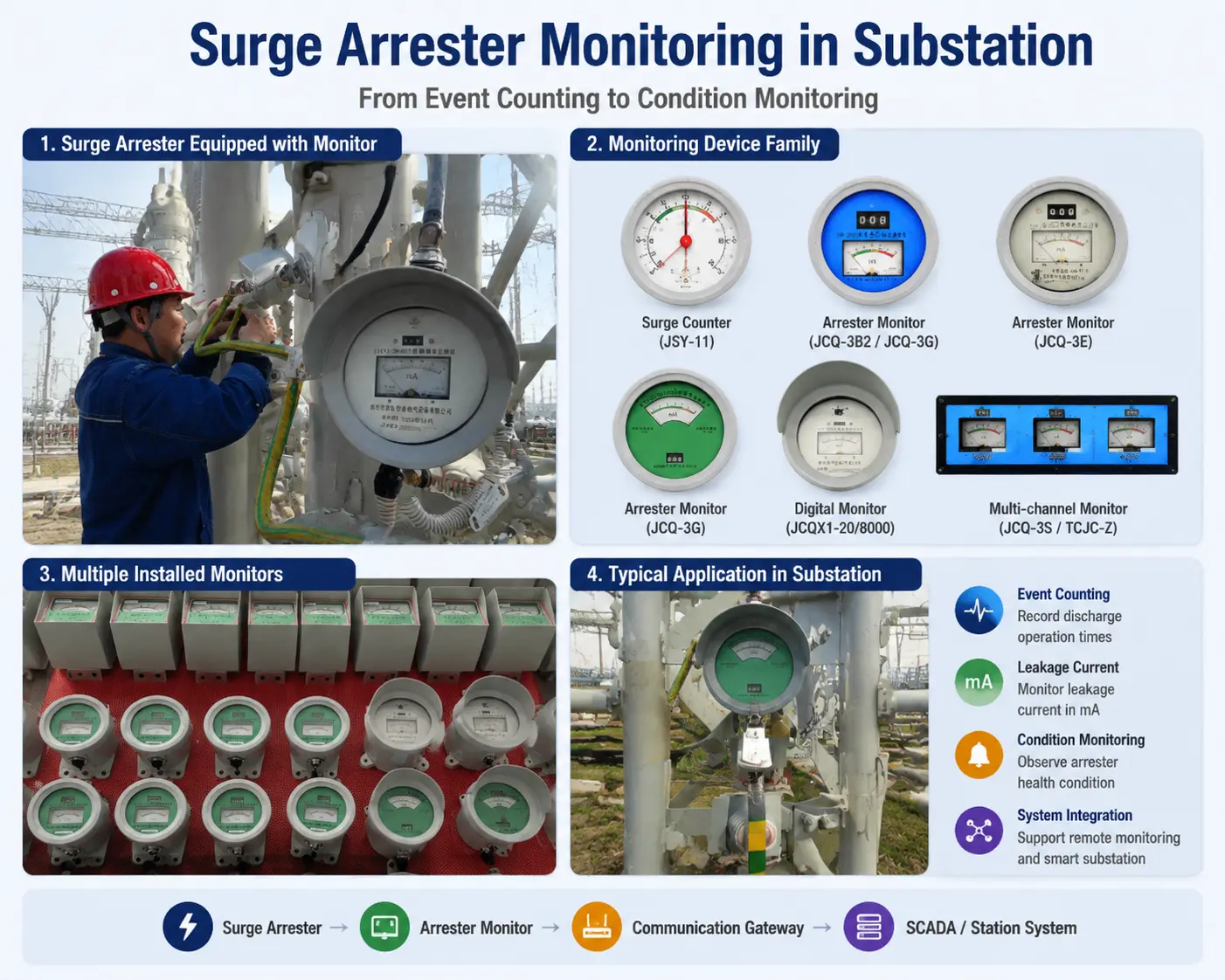
Start With the Monitoring Purpose
Before comparing models, define the actual monitoring purpose. A simple project may only need a surge counter that records arrester operations. A maintenance-focused project may need leakage-current indication. A digital substation or unattended site may need remote signals, alarms, timestamps, and communication with a station system.
If the project is still at the specification stage, review the available LEEYD arrester monitoring solutions first, then match the device level to the required maintenance workflow.
| Monitoring Need | Suitable Device Type | Typical Use |
|---|---|---|
| Record arrester discharge operations | Surge counter | Basic operation counting and inspection records |
| Count operations and observe leakage current locally | Mechanical arrester monitor | Routine substation inspection and condition observation |
| Display current values or alarms more clearly | Digital arrester monitor | Projects that need easier reading and more monitoring detail |
| Send data to a remote system | Online arrester monitoring system | Unattended substations, digital substations, and centralized monitoring |
Confirm the Arrester Type and System Voltage
The monitoring device should be selected together with the arrester and system conditions. Buyers should provide the arrester type, rated voltage, system voltage, grounding arrangement, installation position, and any project-specific standard or technical specification.
For metal oxide arrester projects, the monitor or counter should be matched with the selected zinc oxide surge arresters. The goal is to avoid choosing a monitor only by appearance while missing the electrical and installation requirements behind the arrester system.
Decide Whether Leakage Current Monitoring Is Required
Leakage current is one of the main reasons buyers choose an arrester monitor instead of a simple counter. In many substations, maintenance personnel need to observe whether leakage current changes over time, especially after repeated surge events, long service periods, or abnormal environmental conditions.
When leakage current monitoring is required, confirm what type of current indication is needed. Some projects only require local pointer indication. Others may ask for digital display, alarm contacts, historical records, or remote data output. These requirements affect the model, wiring, accessories, and acceptance checks.
Choose Between Mechanical, Digital, and Online Monitoring
A mechanical arrester monitor is often suitable when operators perform regular site inspections and need reliable local readings. A digital arrester monitor may be preferred when clearer indication, alarm output, or data handling is required. An online monitoring system is more suitable when the site needs centralized supervision or remote maintenance support.
If the buyer is comparing a basic counter with a fuller monitor, it is useful to review the difference between a surge counter vs arrester monitor before finalizing the specification.
| Device Level | Main Function | Best Fit | Key Point to Confirm |
|---|---|---|---|
| Surge counter | Counts discharge events | Basic inspection programs | Counter type, impulse withstand, reset method, mounting |
| Mechanical arrester monitor | Counts events and indicates leakage current locally | Substations with routine manual inspection | Current range, display type, enclosure, installation direction |
| Digital arrester monitor | Shows monitoring values and may support alarms | Sites needing clearer readings or alarm output | Power supply, signal output, alarm thresholds, display method |
| Online monitoring system | Collects, transmits, and manages monitoring data | Digital or unattended substations | Communication protocol, gateway, data mapping, integration test |
Check Installation Space and Wiring Conditions
Installation details can decide whether a monitor fits the project. Confirm the available space near the arrester, grounding conductor layout, mounting bracket requirements, cable routing, reading direction, enclosure protection, and whether the monitor will be installed indoors, outdoors, or inside a switchgear-related structure.
For gas-insulated substation projects, confirm whether the monitoring device will be used with GIS surge arresters. GIS applications may require different installation planning, signal routing, and coordination with the overall station monitoring architecture.
Define Communication and Data Requirements Early
Remote monitoring should be specified only when the project actually needs it. Buyers should define whether the system needs local display, dry contact alarms, analog output, RS485/Modbus, gateway communication, or integration with a higher-level station system. If IEC 61850 or another protocol is required, clarify whether it is handled by the monitor, a gateway, or the station system integrator.
For online monitoring projects, ask the supplier to confirm the data points, alarm logic, timestamp method, communication distance, power supply requirement, and factory acceptance test procedure. These details reduce misunderstanding between the arrester supplier, monitor supplier, panel builder, and system integrator.
Information to Send Before Ordering
A clear RFQ helps the supplier recommend the correct arrester monitor more quickly. Instead of sending only a model name, provide the operating conditions and expected monitoring function.
| Information | What to Provide |
|---|---|
| Arrester type | Zinc oxide arrester, metal oxide arrester, GIS arrester, distribution arrester, or project-specific type |
| Voltage level | System voltage, arrester rated voltage, and installation location |
| Monitoring function | Surge counting, leakage current indication, alarms, remote monitoring, or data collection |
| Installation details | Mounting position, grounding method, available space, cable routing, and enclosure requirement |
| Communication requirement | Local reading only, alarm output, RS485/Modbus, gateway, IEC 61850, or project-defined system interface |
| Project quantity | Number of phases, number of arresters, spare units, and delivery schedule |
Common Selection Mistakes
- Specifying online communication when the site only needs local inspection.
- Choosing a surge counter when leakage-current observation is required.
- Ignoring installation direction, reading position, and grounding layout.
- Assuming every digital monitor can connect directly to the station automation system.
- Not confirming the arrester type and voltage level before selecting the monitor.
Frequently Asked Questions
Is an arrester monitor the same as a surge counter?
No. A surge counter mainly records discharge operations. An arrester monitor may also provide leakage-current indication, alarm output, or communication functions, depending on the model.
When should a substation use an online arrester monitoring system?
Online monitoring makes sense when the site needs remote inspection, centralized alarms, historical records, or integration with a station monitoring system. It is not always necessary for simple manual inspection programs.
What should be confirmed before ordering an arrester monitor?
Confirm the arrester type, voltage level, monitoring function, leakage-current requirement, installation space, grounding method, communication interface, and project quantity.
Can one arrester monitor be used for every surge arrester?
No. The correct device depends on arrester type, system voltage, discharge duty, installation method, and monitoring requirement. The supplier should verify model suitability before order confirmation.
Get a Model Recommendation
To choose the right arrester monitor, send LEEYD your arrester type, voltage level, grounding method, monitoring function, installation conditions, communication requirement, and project quantity. The technical team can recommend a suitable surge counter, local arrester monitor, or online monitoring solution based on the application.