
Shunt Resistor Guide: Current Measurement Basics
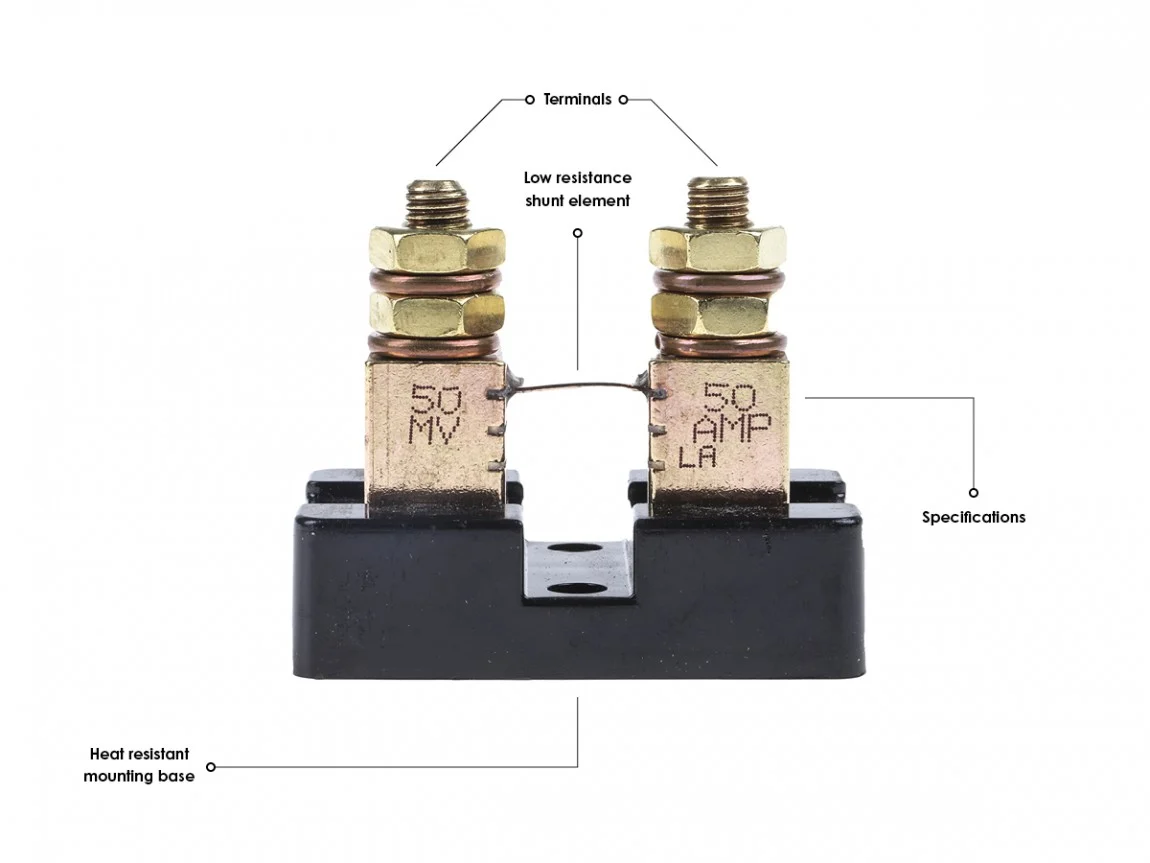
A shunt resistor is a low-resistance component used to measure electric current by producing a small, predictable voltage drop. In high-current DC systems, the shunt carries the main current while a meter, controller, or monitoring device reads the millivolt signal across the sense terminals.
For industrial buyers, this page is the concept entry point. It explains what a shunt resistor is, how it relates to current measurement, and how a larger DC shunt resistor differs from a small PCB current sense resistor. Detailed product selection is handled in the separate DC current shunt selection guide.
If you already know the required current range and output signal, you can also review the LEEYD DC current shunt product series for standard and custom models.
What Is a Shunt Resistor?
A shunt resistor is a precision resistor with a very low resistance value. It is installed in the current path so the load current flows through it. Because the resistance is known, the voltage drop across the shunt can be used to calculate current by Ohm’s law.
In current measurement, a shunt resistor is often called a current shunt, ammeter shunt, DC shunt resistor, or current shunt resistor. These names are often used differently by different industries, but the measurement principle is the same: current creates a measurable voltage drop across a known resistance.
For a general technical definition, see this reference on an electrical shunt. In practical purchasing, however, the exact electrical and mechanical specifications matter more than the name.
How Does a Current Shunt Resistor Work?
A current shunt resistor works by converting current into a small voltage signal. The main current enters and exits through the current terminals. The measuring instrument connects to separate sense points and reads the millivolt output.
The calculation is based on Ohm’s law:
| Voltage | V = I x R |
| Current | I = V / R |
| Resistance | R = V / I |
For example, a 500A/75mV shunt produces 75mV when 500A flows through it. At 250A, the expected output is about 37.5mV. The meter converts this millivolt value into the current reading shown on the display.
Why Use a Shunt Resistor for Current Measurement?
A shunt resistor lets a measuring instrument read high current without forcing the full load current through the meter itself. This is useful in welding equipment, battery systems, EV and energy storage systems, switchgear, power supplies, and test equipment.
Compared with some sensor-based current measurement methods, a shunt can be simple, stable, cost-effective, and accurate when it is selected and installed correctly. The tradeoff is that the shunt creates heat and a small voltage drop, so current rating, thermal conditions, and mounting design must be checked carefully.
DC Shunt Resistor vs Current Sense Resistor
The terms can overlap, but buyers usually use them in different contexts. A current sense resistor is often discussed in electronic circuits and PCB designs. A DC shunt resistor is usually larger and is selected for panel meters, battery monitoring, welding machines, power systems, or other high-current equipment.
| Item | Current Sense Resistor | DC Shunt Resistor |
|---|---|---|
| Typical use | PCB current sensing and control circuits | High-current DC measurement and ammeter systems |
| Current range | Usually lower current | From low current to very high current, depending on design |
| Output signal | Depends on circuit design | Often 40mV, 50mV, 60mV, 75mV, 100mV, or custom |
| Mechanical form | Chip, metal strip, or PCB-mounted component | Busbar, base-mounted, terminal-mounted, or custom structure |
| Buyer focus | Resistance value, TCR, package, power | Current rating, mV output, accuracy, heat, terminals, mounting |
For LEEYD’s product range, the main focus is DC current shunts for industrial current measurement rather than small PCB-only resistors.
Common Shunt Resistor Ratings
Shunt resistors are usually specified by current rating and full-scale voltage drop. A complete specification should look like 100A/75mV, 500A/75mV, or 1000A/50mV. The current value alone is not enough.
| Specification | What It Means | Why Buyers Should Confirm It |
|---|---|---|
| Rated current | Maximum current at full-scale output | Determines the main current capacity |
| Voltage drop | Millivolt output at rated current | Must match the meter or control input |
| Accuracy class | Permitted measurement error under defined conditions | Affects monitoring and control reliability |
| Resistance value | Calculated from voltage drop and current | Defines output signal and heat |
| Power dissipation | Heat generated at current load | Impacts temperature rise and installation design |
For more detail on 75mV output selection, read the 75mV shunt guide.
How to Calculate Shunt Resistor Value
To calculate shunt resistance, divide the full-scale voltage drop by the rated current. Use volts and amps in the formula.
| Formula | Resistance = Voltage drop / Rated current |
| Example | 75mV / 100A = 0.00075 ohm |
| In micro-ohms | 0.00075 ohm = 750 micro-ohms |
Power dissipation can be calculated as current multiplied by voltage drop. A 100A/75mV shunt dissipates about 7.5W at full current. A 1000A/75mV shunt dissipates about 75W. This is why high current shunt resistor design must consider heat, airflow, terminal material, and installation space.
What Makes a Shunt Resistor Suitable for High Current?
A high current shunt resistor must do more than provide a low resistance value. It must carry the rated current, produce a stable millivolt signal, control temperature rise, and provide a mechanical structure that fits the power circuit.
For full model selection, use the DC current shunt selection guide. For installation details, use the DC shunt wiring diagram guide.
Where the Concept Applies
The same shunt resistor principle appears in PCB current sensing, panel ammeters, battery monitoring, welding equipment, EV systems, switchgear, and test equipment. LEEYD mainly focuses on industrial DC current shunts rather than small PCB-only components.
Next Step for Industrial DC Current Measurement
After understanding the basic shunt resistor concept, the next step is to match the component to the real system. That means confirming current rating, millivolt output, accuracy, thermal conditions, and installation layout. View the LEEYD DC current shunt product series when you are ready to compare standard and custom models.
FAQ About Shunt Resistors
What is a shunt resistor used for?
A shunt resistor is used to measure current by creating a small voltage drop that can be read by a meter or controller.
Is a current shunt resistor connected in series or parallel?
For current measurement, the shunt is installed in series with the load current path. The measuring instrument connects across the sense terminals to read the voltage drop.
How do I choose a shunt resistor?
Start by confirming the current range and the required millivolt output. For a complete industrial selection process, use the dedicated DC current shunt selection guide.
What is the difference between a shunt resistor and a normal resistor?
A normal resistor may be used for many circuit functions. A shunt resistor is selected for precise low-resistance current measurement and must handle current, heat, and accuracy requirements.
Can LEEYD make custom current shunt resistors?
Yes. LEEYD supports standard and custom DC current shunts for industrial current measurement applications.
Need a current shunt resistor for an industrial DC system? Start with the concept here, then use LEEYD’s product and selection pages to confirm the exact model or custom design requirements.