
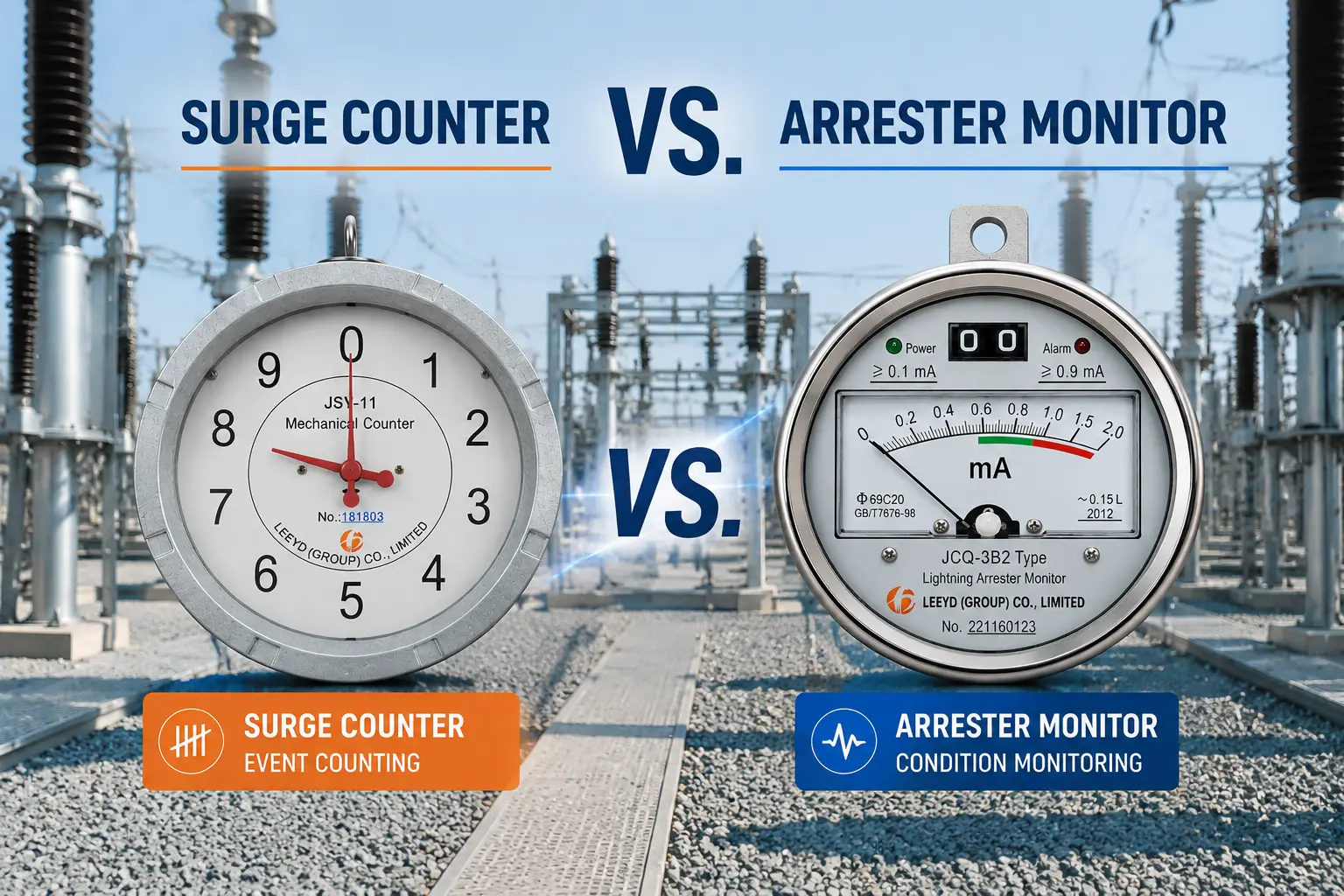
This guide explains surge counter vs arrester monitor selection for power systems where maintenance teams need to record arrester operations, observe leakage current, or send monitoring data to a remote system. A surge counter records qualifying discharge events passing through a surge arrester. A local arrester monitor may combine discharge counting with leakage-current indication. More advanced online systems may provide timestamps, alarms, history, and communication, depending on model and system architecture.
Before selecting a monitoring device, confirm:
- whether the project needs event counting only or leakage-current observation;
- whether readings will be collected locally or sent to a station system;
- which electrical, environmental, installation, and communication requirements must be verified.
What Does Each Device Actually Do?
The term arrester monitoring covers several different product levels. Treating them as interchangeable can create an incomplete specification or unnecessary system complexity.
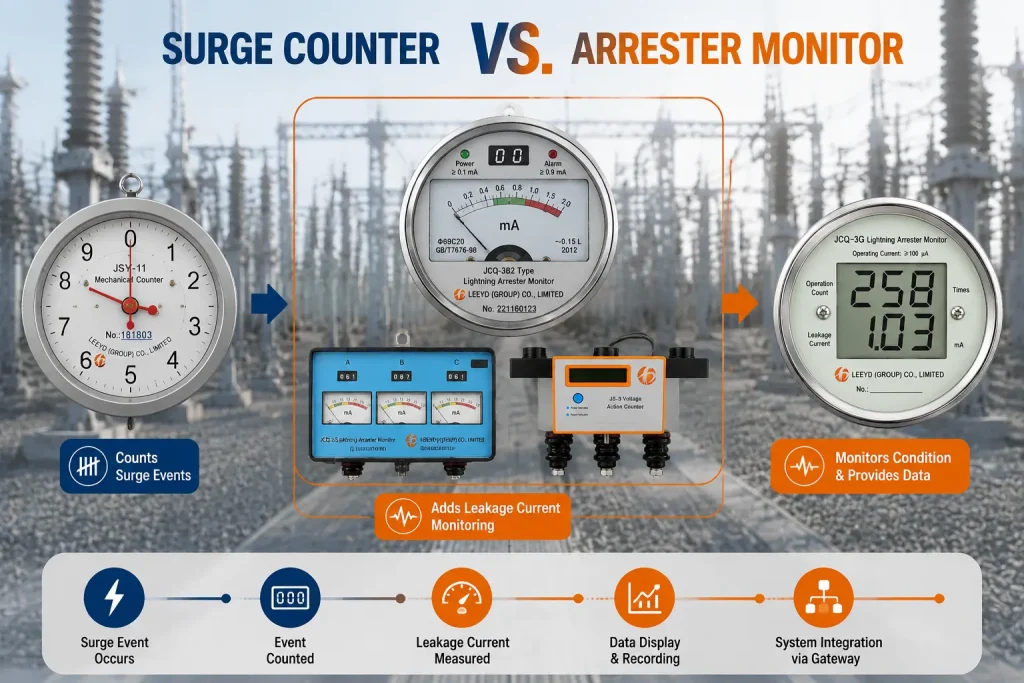
Surge counter
A surge counter is installed in the arrester discharge path and records operations caused by current impulses passing through the arrester. In the reviewed JS(Y) series, the discharge current creates a voltage across a sampling element. A rectifier charges a capacitor, and the stored energy operates an electromagnetic counter.
The display may use one pointer, two pointers, or mechanical digit wheels. A mechanical numeric display should not be confused with an electronic monitor. The counter records events locally but does not measure leakage current or determine arrester condition.
Local arrester monitor
In this guide, a local arrester monitor refers to a model that combines a discharge-counting unit with a local leakage-current indicator. This is not a universal definition for every product sold as an arrester monitor.
For the reviewed JCQ-3B2 model, the manual specifies a three-digit event counter and a nonlinear milliampere scale. The JCQ-3B2 scale is linear from 0 to 1 mA and nonlinear from 1 to 3 mA.
This reading supports trend observation during inspections. It is not a revenue-grade or laboratory measurement. The JCQ-3B2 instructions also state that the device cannot replace routine preventive testing of the arrester.
Digital online monitor
A digital online monitor may add electronic acquisition, records, alarm settings, and communication, depending on the model and ordered configuration.
The reviewed three-phase TCJS-Z model uses CT sensors to acquire signals from three arresters. According to the reviewed TCJS-Z documentation, the unit displays the count, total leakage-current RMS value, and latest event time for each phase. The same TCJS-Z documentation describes historical event storage and alarm contacts.
This type of device requires more than a local monitor. The project must account for auxiliary power, CT installation, wiring, panel space, electromagnetic conditions, communication options, and system commissioning.
Communication gateway
A communication gateway does not count arrester operations or measure leakage current by itself. It collects data from field devices, processes or maps that data, and forwards it to an upper-level system.
For example, a gateway may collect data over RS-485 and communicate with a station system using IEC 61850 after the required protocol and point mapping are configured. This does not mean that every connected arrester monitor directly supports IEC 61850.
Surge Counter vs. Arrester Monitor: Key Differences
| Decision factor | Surge counter | Local arrester monitor | Digital online monitor | Communication gateway |
|---|---|---|---|---|
| Primary function | Record discharge events | Count events and indicate leakage current locally, depending on model | Acquire current, count events, record time, and support alarms, depending on model | Collect, convert, and forward device data |
| Leakage-current indication | No | Yes, depending on model | Yes, depending on sensor and configuration | No independent measurement |
| Event history | Current accumulated display | Current accumulated display | Stored records may be available | Depends on gateway software and project configuration |
| Local inspection | Required | Required for local readings | Possible through a display; remote functions may also be configured | Normally inspected as part of the communication system |
| Auxiliary power | Verify by model; the reviewed JS(Y) mechanical series does not specify a separate supply | Verify by model | Required for the reviewed TCJS-Z model | Required for the reviewed IED-900A gateway; confirm supply type and redundancy by model |
| Remote communication | Not part of the reviewed JS(Y) mechanical series | Not established for the reviewed JCQ-3B2 model | Optional RS-485 on the reviewed TCJS-Z model; it must be specified when ordered | Protocols depend on the selected gateway and project configuration |
| Main selection risk | Assuming a count reveals arrester health | Treating an indicative current reading as a diagnostic result | Omitting power, sensor, wiring, or protocol requirements | Assuming protocol support guarantees plug-and-play integration |
The table compares functional levels, not universal product specifications. Current range, impulse capability, housing, voltage application, environmental limits, and interfaces must be confirmed for the selected model.
When Is a Surge Counter Enough?
A surge counter is appropriate when the maintenance task is limited to recording how often the arrester discharge path has carried qualifying impulses. It offers a simple local record without adding current measurement, alarms, or a communication network.
The following values apply only to the reviewed JS(Y) series. They are not universal surge-counter specifications.
The reviewed JS(Y) manual identifies a 10 kA nominal discharge current, 800 A for a 2 ms square-wave current, and 100 kA for a 4/10 μs high-current impulse. The same manual limits that series to arresters rated at 220 kV and below.
A counter alone is not enough when the maintenance plan requires leakage-current trends, phase-by-phase alarms, timestamps, remote records, or integration with a substation automation system.
One more distinction matters: an operation count is not automatically a lightning count. An arrester can conduct during different overvoltage events. The counter indicates that a qualifying discharge event occurred. It does not identify the event source or prove damage.
When Should Buyers Select an Arrester Monitor?
Select a local arrester monitor with both functions when technicians need an accumulated operation count and an on-site indication of leakage-current change. Confirm those functions for the selected model; the product name alone does not establish them.
This type of device provides more inspection information than a counter, but it still has clear limits.
For the reviewed JCQ-3B2 model, the leakage-current indication is intended for relative observation. The JCQ-3B2 instructions warn that the reading should not be treated as a metering result. A change can prompt further inspection, but the instrument does not establish the root cause by itself.
The buyer should provide the arrester model, system voltage, applicable project specification, installation conditions, and any available discharge-duty requirements. The supplier should then verify the selected monitor’s ratings against the arrester and project requirements.
The final specification should define:
- whether the monitor shows total, resistive, nonlinear, or another current component;
- the current range and indication error;
- the discharge-duty and residual-voltage requirements that the selected monitor must satisfy;
- indoor or outdoor use, ambient temperature, altitude, vibration, contamination, and mounting conditions;
- display type and count capacity;
- acceptance testing and the method for recording baseline readings.
Do not use one universal percentage increase as a condition threshold across all products. A maintenance trigger found in one model manual may depend on that monitor, the arrester, the installation, and the operator’s maintenance procedure.
When Does Online Monitoring Make Sense?
For gas-insulated substations, confirm whether the monitoring device will be installed with GIS surge arresters and whether the project requires local indication, remote signals, or integration through a station communication system.
Online monitoring makes sense when operators need time-based records, phase comparison, alarms, or remote data instead of periodic manual readings alone.
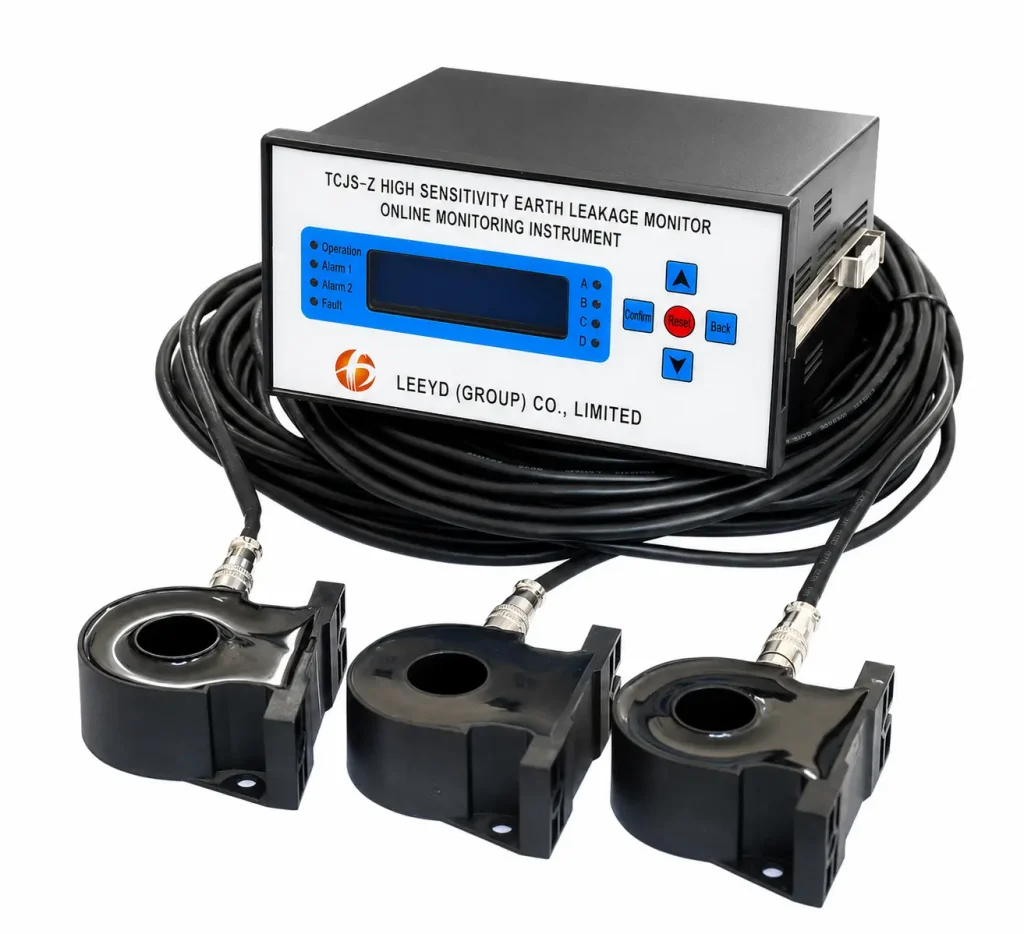
Model-specific example: The following values apply only to the reviewed TCJS-Z documentation. They are not universal arrester-monitor specifications.
The reviewed TCJS-Z model monitors three arresters through CT sensors. The TCJS-Z documentation specifies a total leakage-current RMS range of 0 to 3 mA, operation count and event-time recording for each phase, and configurable alarm thresholds. The reviewed TCJS-Z model can retain 100 event records per phase before older records are overwritten.
Those functions introduce additional engineering requirements:
- Auxiliary power: The reviewed TCJS-Z documentation specifies AC 85–305 V or DC 100–430 V and power consumption of no more than 2 W.
- Sensor installation: For the reviewed TCJS-Z arrangement, the arrester grounding lead must be routed through the specified CT according to the model’s wiring diagram. A parallel grounding path that bypasses the sensor can invalidate the reading.
- Panel and wiring: The reviewed TCJS-Z model uses embedded panel installation and separate CT, alarm, power, grounding, and optional communication terminals.
- Communication order code: RS-485 is optional for the reviewed TCJS-Z model and must be specified when ordering.
- Site conditions: The reviewed TCJS-Z instructions state that this model is not suitable for especially complex electromagnetic interference conditions.
Installation and commissioning must follow the approved high-voltage safety procedure for the project and the wiring instructions for the exact model.
These points explain why an online monitor should be treated as a small monitoring system, not as a direct replacement for a mechanical counter.
How Should IEC 61850 Integration Be Specified?
IEC 61850 integration should be specified as a complete data path, not as a label attached to the field monitor.
A typical architecture may be:
Arrester sensors and online monitor → RS-485 and device protocol → communication gateway → IEC 61850 station network
The reviewed TCJS-Z documentation describes an optional RS-485 interface using a Modbus-like RTU protocol. The reviewed IED-900A gateway has eight RS-485 ports, two RJ45 Ethernet ports, and two multimode optical ports. The reviewed IED-900A software platform lists IEC 61850 among the protocols that can be configured.
The cited TCJS-Z and IED-900A devices illustrate a possible architecture. They must not be treated as a prevalidated compatible package unless protocol mapping and system tests have been completed.
Before approval, the buyer should verify:
- the exact field-device communication option;
- register map and data definitions;
- number of monitors per communication segment;
- event timestamps and time-synchronization method;
- alarm and status points required by the station;
- IEC 61850 logical-node and data mapping;
- gateway configuration responsibility;
- factory acceptance and site acceptance test procedures.
A gateway with an IEC 61850 software library still requires project-specific configuration. Protocol names alone do not confirm that the required arrester data will appear correctly in the substation automation system.
What Should Be Verified Before Purchase?
Use the following sequence to keep the RFQ tied to the actual maintenance task.
1. Define the information required
Choose among event count, local leakage-current indication, current trend records, timestamps, alarms, phase comparison, and remote communication. Do not request functions that will not be used or maintained.
2. Match the arrester and discharge duty
Provide the arrester model, system voltage, applicable project specification, installation position, and any available discharge-duty requirements. The supplier should verify the monitor’s impulse and current-withstand ratings against the selected arrester and project requirements.
For metal oxide protection projects, the monitoring device should be matched with the selected zinc oxide surge arresters, system voltage, grounding method, and expected discharge duty. This prevents a counter or monitor from being chosen only by appearance or mounting style.
3. Define the measured current
State whether the project requires total leakage current, resistive current, or another component. Confirm the range, scale type, error limit, alarm logic, and whether the value is indicative or intended for a defined diagnostic method.
4. Confirm installation conditions
Provide indoor or outdoor location, temperature, altitude, contamination, vibration, mounting angle, available dimensions, grounding arrangement, conductor details, and viewing access.
5. Define remote-system requirements
For online monitoring, identify the auxiliary supply, CT arrangement, alarm contacts, RS-485 requirement, field protocol, gateway, station protocol, data-point list, time synchronization, and commissioning responsibility.
6. Agree on acceptance checks
Inspection should cover the nameplate, documents, accessories, housing, insulator, terminals, dimensions, counter operation, and current indication when applicable.
A dedicated tester can simulate count pulses and provide defined current points for checking counters and monitor indicators. The approved procedure must match the exact product instructions and the project’s safety rules.
Frequently Asked Questions
Does a surge counter measure arrester leakage current?
No. A basic surge counter records qualifying discharge events but does not provide a leakage-current reading. If technicians need to observe current during inspection, specify a monitor with the required current component and range. Confirm the functions of the exact model before comparing products.
Is an arrester monitor a diagnostic instrument?
Not automatically. A local monitor may show an operation count and a relative leakage-current trend, depending on the model. One reading does not identify moisture, aging, contamination, or mechanical damage by itself. Compare readings against an approved baseline and maintenance procedure, and retain the arrester’s required preventive tests.
Does a mechanical digit counter need an external power supply?
The reviewed JS(Y) mechanical series uses energy from the discharge pulse to operate its counting mechanism, and the reviewed JS(Y) manual does not specify a separate auxiliary supply. This statement applies only to that reviewed series. Buyers must confirm the requirement for the selected model.
Can an arrester monitor connect directly to IEC 61850?
Only if the exact device supports the required interface and data model. A monitor with RS-485 and a field protocol may need a separate gateway to exchange data with an IEC 61850 station system. Verify the register map, gateway configuration, point mapping, timestamps, alarms, and acceptance tests.
What information should be included in an RFQ?
Provide the arrester model, system voltage, applicable project specification, required monitoring functions, measured-current type and range, environmental conditions, mounting dimensions, auxiliary supply, communication interface, station protocol, quantities, and acceptance requirements. For a communication project, include the required data-point list and proposed system architecture.
Review the Required Monitoring Level
Start by defining what maintenance personnel must know: event count only, local leakage-current change, time-based alarms, or remote station data. Then compare that requirement with the available LEEYD arrester monitoring solutions.
A function-by-function review helps prevent a simple counter from being overspecified and an online monitoring project from being underspecified.