
Arrester leakage current monitoring helps utility and substation teams observe the operating condition of surge arresters after installation. A surge arrester may look normal from the outside, but leakage current trends, operation counts, and alarm records can give maintenance teams better information for inspection planning.
This article explains what an arrester leakage current monitor does, which data buyers should request, and how to specify a monitoring device for substations, transmission networks, GIS equipment, and industrial power systems.
What Is Arrester Leakage Current?
Leakage current is the small current that flows through a surge arrester during normal operation. For metal oxide arresters, this current is related to the arrester’s internal resistance, operating voltage, insulation condition, contamination, moisture, temperature, and service history.
A single reading is not always enough to judge arrester condition. In many maintenance programs, the value becomes more useful when it is compared with previous readings, phase-to-phase differences, operating conditions, and the number of recorded discharge events.
Why Utility Buyers Monitor Leakage Current
Utilities and industrial power users monitor leakage current because surge arresters are critical protection devices. If an arrester deteriorates, the risk is not only the arrester itself. The connected transformer, GIS bay, cable system, switchgear, or overhead line equipment may also be exposed to higher overvoltage risk.
For buyers reviewing LEEYD arrester monitoring solutions, leakage current monitoring is usually specified when the project needs more than simple operation counting. It is especially useful when the maintenance team wants local condition indication, periodic inspection data, or remote monitoring signals.
| Buyer Need | Why Leakage Current Monitoring Helps |
|---|---|
| Routine inspection | Provides a local value that can be recorded and compared over time |
| Condition observation | Supports maintenance decisions when readings change unexpectedly |
| High-value equipment protection | Helps monitor arresters protecting transformers, GIS, and power system assets |
| Remote maintenance | Allows monitoring data or alarms to be transmitted when the system supports it |
| Post-surge review | Combines operation count and leakage-current changes after discharge events |
What an Arrester Leakage Current Monitor Measures
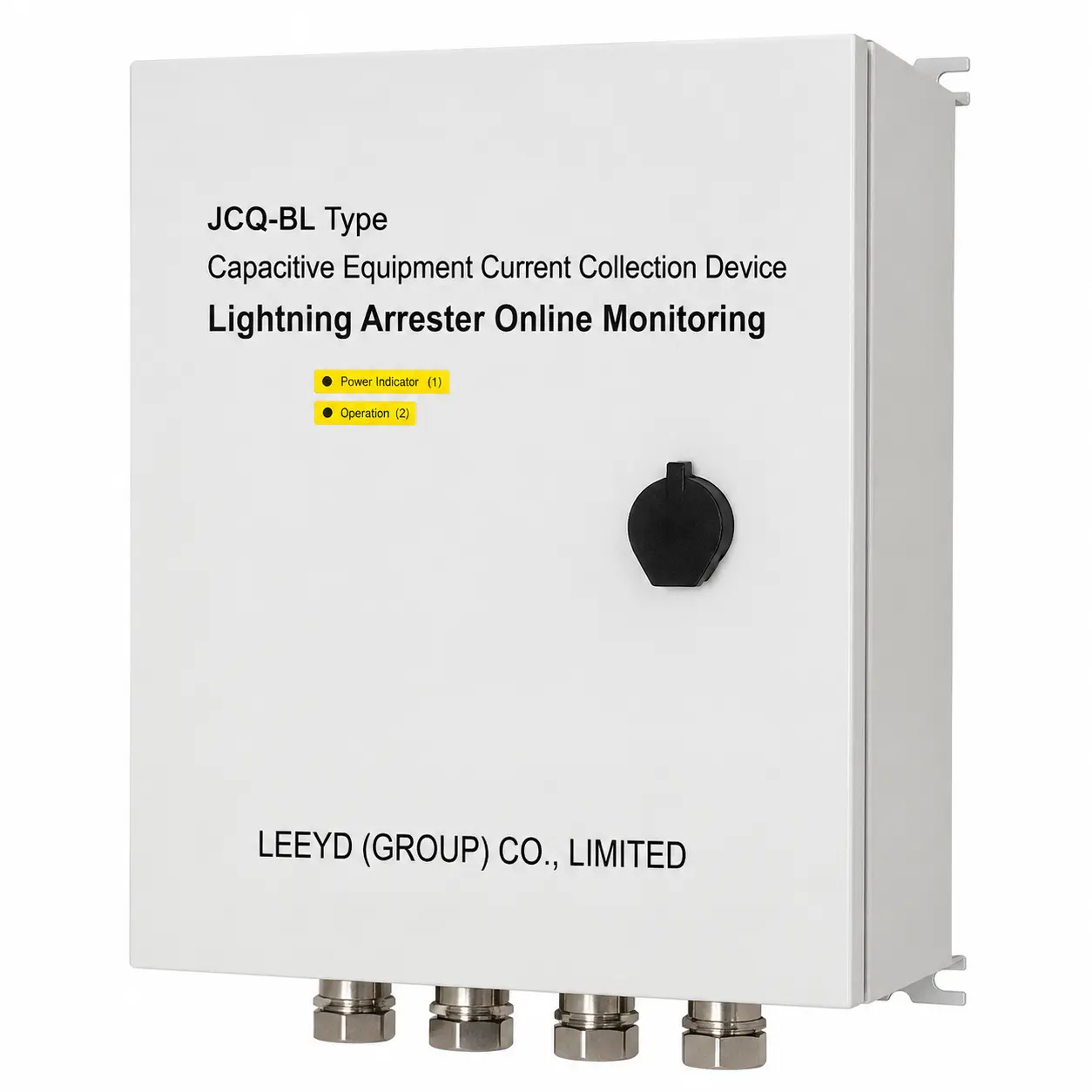
Different arrester monitors provide different levels of information. A mechanical monitor may show leakage current locally with a pointer or scale. A digital monitor may display values more clearly and support alarm output. An online monitoring system may collect data from multiple arresters and transmit it to a station-level system.
When comparing models, buyers should avoid assuming that every monitor provides the same data. Confirm whether the device measures total leakage current, supports resistive current analysis, records surge operations, provides alarm contacts, or communicates through a defined interface.
| Monitoring Function | Typical Purpose | What to Confirm |
|---|---|---|
| Leakage current indication | Local observation during inspection | Current range, display method, accuracy class, reading position |
| Surge operation counting | Record arrester discharge events | Counting threshold, impulse withstand, reset method, mechanical or digital display |
| Alarm output | Notify abnormal condition or threshold crossing | Alarm logic, contact type, threshold setting, power supply requirement |
| Remote data collection | Centralize monitoring information | Communication method, gateway, protocol, cable distance, data points |
| History and trend data | Support maintenance comparison over time | Storage method, timestamp, software or station integration responsibility |
Surge Counter vs Leakage Current Monitor
A surge counter and an arrester leakage current monitor are related, but they are not the same. A counter records qualifying discharge operations. A leakage current monitor helps maintenance personnel observe current behavior during normal service. Many arrester monitors combine both functions, but the exact configuration depends on model and project requirements.
If the project team is still deciding between basic operation counting and fuller monitoring, compare the difference in this guide to surge counter vs arrester monitor selection before confirming the RFQ.
Where Leakage Current Monitoring Is Commonly Used
Leakage current monitoring is often used where arrester condition matters to system reliability and maintenance planning. Typical applications include substations, transmission networks, transformer protection, GIS equipment, railway and industrial power systems, and sites where local inspection is difficult or costly.
For projects using zinc oxide surge arresters, leakage-current monitoring can support periodic inspection and condition tracking. For gas-insulated substations, monitoring requirements should also be coordinated with the installation layout of GIS surge arresters and the station communication system.
How to Specify an Arrester Leakage Current Monitor
A good specification should describe the arrester, the system, the monitoring purpose, and the installation conditions. Sending only a requested model number may not be enough, especially for customized monitoring panels or online monitoring systems.
| Specification Item | Information to Provide |
|---|---|
| Arrester type | Metal oxide arrester, zinc oxide arrester, GIS arrester, distribution arrester, or other type |
| Voltage level | System voltage, arrester rated voltage, installation point, and grounding method |
| Monitoring requirement | Leakage current indication, operation counting, alarm output, remote monitoring, or full data collection |
| Display method | Pointer, mechanical counter, digital display, local panel, or remote software |
| Communication | Local only, alarm contact, RS485/Modbus, gateway, IEC 61850 mapping, or project-defined protocol |
| Installation conditions | Indoor/outdoor use, mounting space, cable routing, enclosure requirement, and reading direction |
| Project scope | Number of phases, number of arresters, spare units, delivery schedule, and testing requirement |
Mechanical, Digital, and Online Monitoring Options
Mechanical arrester monitors are suitable for many substations where routine manual inspection is still the main maintenance method. They are simple to read locally and can combine operation counting with leakage-current indication.
Digital arrester monitors are useful when buyers need clearer values, alarm functions, or easier integration with a monitoring cabinet. Online monitoring systems are better suited for digital substations, unattended sites, or projects where monitoring data must be collected from several arrester positions.
If the project has not yet selected the device level, review the practical selection factors in how to choose an arrester monitor for substation surge arresters.
Common Mistakes to Avoid
- Specifying leakage current monitoring without defining the required current range or display method.
- Assuming a surge counter can provide arrester condition information by itself.
- Requesting online communication without confirming protocol, data points, gateway responsibility, and acceptance tests.
- Ignoring outdoor enclosure, cable routing, grounding method, or available mounting space.
- Comparing monitors only by price while the actual project needs different functions.
Frequently Asked Questions
What does an arrester leakage current monitor do?
It indicates or collects leakage current information from a surge arrester during operation. Depending on the model, it may also count discharge events, provide alarms, or support remote data transmission.
Is leakage current monitoring required for every surge arrester?
No. Some applications only require a surge counter or routine visual inspection. Leakage current monitoring is more useful when the project requires condition observation, maintenance records, alarms, or remote monitoring.
Can leakage current monitoring predict arrester failure?
It should be treated as a monitoring and maintenance support tool, not a guaranteed failure prediction method. Readings should be reviewed together with operating conditions, inspection results, discharge history, and project maintenance procedures.
What information should be sent to the supplier?
Send the arrester type, voltage level, grounding method, monitoring function, current indication requirement, communication requirement, installation space, and project quantity.
Request a Suitable Monitoring Solution
To select the right arrester leakage current monitor, send LEEYD your arrester type, voltage level, monitoring purpose, installation conditions, communication requirement, and quantity. LEEYD can help review whether the project needs a surge counter, mechanical arrester monitor, digital monitor, or online monitoring system.