

A usable custom DC shunt RFQ must define the electrical rating, current profile, millivolt output, accuracy requirement, operating conditions, mechanical interface, validation method, and order context. Rated current alone is not enough. Missing data can produce a quotation for a shunt that fits the current range but does not match the meter, mounting space, thermal conditions, or acceptance method.
Before requesting a custom DC shunt quotation, buyers should confirm:
- The continuous, peak, and overload current conditions.
- The required millivolt output and measuring-device input.
- The available space, terminals, mounting pattern, and validation criteria.
Start With the Application and Measurement Function
The supplier needs to understand what the shunt will measure and where it will operate. This context affects the electrical design, mechanical structure, and review questions.
Identify the Equipment and Application
State whether the shunt is intended for industrial power equipment, welding equipment, DC switchgear, battery systems, test equipment, or another application.
Describe the shunt’s role in the system. For example, it may provide a signal to a panel meter, controller, protection circuit, or data-acquisition device.
Also state whether the project is a new design or a replacement. A replacement project usually requires more interface data. The new shunt must work with an existing meter, busbar, enclosure, and mounting pattern.
Explain the Measurement Objective
Specify whether the shunt is used for indication, control, protection, energy monitoring, or laboratory measurement. These functions may require different accuracy, response, stability, and documentation levels.
Do not describe the requirement only as “high accuracy.” Define the required accuracy class or system-level measurement target.
The complete measurement chain includes the shunt, signal wiring, instrument input, connections, and operating temperature.
Describe the Electrical Environment
Include the DC system voltage and grounding arrangement when relevant. Also identify nearby heat sources, airflow, enclosure conditions, and the expected ambient temperature range.
The system voltage does not determine the shunt’s millivolt output. However, it can affect insulation, spacing, installation, and safety review.
Define the Electrical Specifications
Electrical specifications are the core of a custom DC shunt RFQ. Buyers should provide the operating profile, not just the largest current shown on a system label.
Separate Continuous Current From Peak Current
Rated current refers to the current value used with the rated millivolt output. It should not be treated as a complete duty-cycle statement.
Provide these values separately:
- Normal operating current.
- Maximum continuous current.
- Peak or overload current.
- Peak duration.
- Number or frequency of peaks.
- Recovery time between peaks.
This distinction is important for welding machines, motor drives, battery systems, and other loads with changing current.
A brief peak and a continuous load can create very different thermal conditions.
Match Current and Millivolt Output to the Instrument
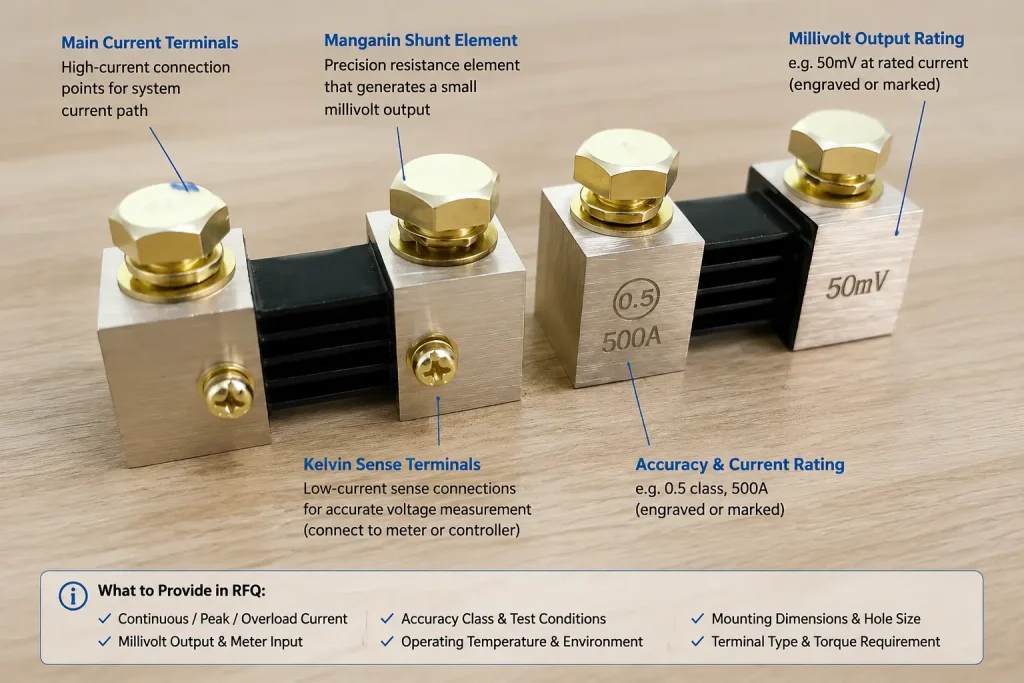
A DC shunt produces a small voltage signal proportional to current. The specified current and millivolt output form a matched pair, such as 500 A/75 mV.
Common output options shown in LEEYD’s product range include 40 mV, 50 mV, 60 mV, 75 mV, and 100 mV. Availability depends on the selected model and configuration.
The required output must match the input of the meter, controller, or converter.
Use the following relationship for a preliminary check:
Shunt resistance = Rated millivolt output ÷ Rated current
For example, a 500 A/75 mV shunt has a nominal resistance of:
0.075 V ÷ 500 A = 0.00015 Ω
At 300 A, its ideal output is:
300 A × 0.00015 Ω = 0.045 V, or 45 mV
This calculation checks signal scaling. It does not replace thermal or application review.
If the instrument input is unknown, provide its model number and input specification. Do not ask the supplier to select the output from rated current alone.
State Accuracy and Acceptance Conditions
Include the required accuracy class and the conditions under which it must be verified.
At minimum, the RFQ should identify:
- Test current.
- Rated voltage drop.
- Permitted tolerance.
- Ambient or stabilization condition.
- Required inspection or test records.
Accuracy claims are meaningful only when the test conditions are clear.
If the project has a system-level accuracy target, separate the permitted shunt error from errors introduced by wiring and the instrument.
| RFQ Field | What the Buyer Should Provide | Risk if Omitted |
|---|---|---|
| Rated current | Required current rating in amperes | The quotation may not match the measurement range |
| Continuous current | Maximum current and operating duration | Thermal suitability cannot be reviewed |
| Peak current | Magnitude, duration, frequency, and recovery time | Short-term loading may be misunderstood |
| Millivolt output | 40, 50, 60, 75, or 100 mV when applicable | The shunt may not match the instrument input |
| Accuracy | Required class or tolerance and test condition | Buyer and supplier may use different acceptance methods |
| System voltage | DC voltage and relevant insulation context | Installation requirements may be incomplete |
For a broader explanation of these choices, see the DC current shunt selection guide.
Define Dimensions, Terminals, and Mounting
A shunt can meet the electrical rating and still fail the project because it does not fit the busbar, enclosure, or signal wiring.
Provide a Controlled Drawing
The preferred input is a dimensioned drawing with units and revision identification.
Include:
- Overall length, width, and height.
- Mounting-hole diameter and center spacing.
- Current-terminal dimensions.
- Potential-terminal type and position.
- Clearance limits.
- Mounting orientation.
- Restricted areas around the shunt.
A photograph helps explain the assembly, but it does not reliably define dimensions or tolerances.
For a replacement project, send the original part number, available drawing, clear photographs, and a physical reference sample when practical.
Define the Current and Potential Connections
The current terminals carry the measured current. The potential terminals provide the millivolt signal to the measuring device.
These functions should remain separate so the signal is taken from the intended sensing points.
Specify:
- Current-terminal interface.
- Signal-terminal style.
- Fastener details.
- Cable direction.
- Busbar dimensions, when applicable.
- Available assembly access.
If the shunt connects directly to busbars, include the busbar thickness and hole pattern.
State Installation and Cooling Conditions
Describe whether the shunt is:
- Base-mounted.
- Busbar-mounted.
- Installed inside an enclosure.
- Naturally ventilated.
- Exposed to forced airflow.
Also identify nearby heat sources and space restrictions.
Do not apply a universal derating percentage without supporting test data. Continuous-current suitability depends on the shunt design, duty cycle, connection quality, airflow, orientation, and ambient conditions.
Define Sample Validation and Required Records
A sample request should have a clear validation purpose. Otherwise, the buyer and supplier may evaluate different characteristics.
List the Sample Approval Checks
The approval plan may include:
- Rated voltage-drop verification.
- Resistance or output consistency.
- Critical dimensions and hole spacing.
- Terminal and mounting fit.
- Output polarity and signal connection.
- Temperature behavior under the agreed load profile.
- Markings, appearance, and packaging when relevant.
The exact checks should follow the confirmed specification and intended application.
LEEYD notes that prototype or sample evaluation can support dimensional, installation, electrical, and application validation for custom projects.
Request Only the Documents the Project Needs
State whether the project requires:
- An inspection report.
- A dimensional report.
- An electrical test record.
- Drawing approval.
- Material information.
- Selected compliance documents.
Document availability can depend on the model and configuration.
Buyers should confirm the required deliverables before ordering. They should not assume that every certificate applies to every custom design.
Agree on Revision and Change Control
The approved drawing should carry a revision number. The purchase order should refer to the approved revision and electrical specification.
If a sample is approved, record which characteristics were accepted and which remain subject to production inspection.
A sample alone should not become the only specification. Physical samples can be damaged, measured differently, or interpreted without agreed tolerances.
Add the Commercial and Project Information
Commercial information helps the supplier choose a practical development route and prepare a comparable quotation. It should not replace the technical specification.
Separate Prototype Quantity From Production Demand
Provide:
- Prototype quantity.
- Initial order quantity.
- Estimated annual demand.
- Expected order frequency.
Mark estimates clearly.
A supplier may need different tooling, inspection, packaging, or production arrangements for a small validation lot and recurring production.
State Timing and Delivery Context
Include:
- Requested sample date.
- Target production schedule.
- Destination country.
- Project milestones that affect approval.
Avoid giving only “urgent” as a delivery requirement. A specific date allows the supplier to review feasibility.
Include Marking and Packaging Requirements
Specify the required:
- Part number.
- Polarity marks.
- Electrical rating marks.
- Product labels.
- Individual packaging.
- Batch identification.
- Export packaging.
These details may affect the quotation and should be reviewed before sample approval.
| Stage | Minimum Information | Purpose |
|---|---|---|
| Preliminary technical review | Application, rated current, current profile, millivolt output, accuracy target, and approximate dimensions | Determine whether the request is technically reviewable |
| Formal quotation | Confirmed electrical data, drawing or interface details, quantity, documents, packaging, destination, and timing | Prepare a comparable commercial offer |
| Sample approval | Controlled drawing, acceptance tests, tolerances, markings, revision, and approval responsibilities | Prevent different interpretations during validation |
| Production order | Approved revision, order quantity, agreed inspection records, packaging, and delivery terms | Maintain the approved configuration |
Custom DC Shunt RFQ Checklist
Buyers can copy this checklist into an RFQ or engineering inquiry.
Application Information
- Equipment or system:
- Measurement function:
- New design or replacement:
- DC system voltage:
- Meter, controller, or converter model:
- Operating environment:
Electrical Requirements
- Rated current:
- Normal operating current:
- Maximum continuous current and duration:
- Peak or overload current:
- Peak duration and frequency:
- Recovery time between peaks:
- Rated millivolt output:
- Required accuracy class or tolerance:
- Test current and acceptance condition:
Mechanical Requirements
- Maximum overall dimensions:
- Mounting-hole diameter and spacing:
- Current-terminal dimensions:
- Potential-terminal type and location:
- Mounting method and orientation:
- Busbar or cable interface:
- Drawing revision or reference sample:
Validation and Supply Requirements
- Prototype quantity:
- Sample approval tests:
- Required reports or documents:
- Marking and labeling:
- Packaging:
- Initial order quantity:
- Estimated annual demand:
- Requested sample date:
- Requested production date:
- Delivery destination:
Available standard and custom configurations can be reviewed on the LEEYD DC shunt product page.
Frequently Asked Questions
Can a Supplier Quote a Custom DC Shunt if the Millivolt Output Is Unknown?
A supplier may provide a preliminary discussion, but the final electrical quotation should not be confirmed without the output requirement.
The millivolt value must match the measuring device’s input range. If it is unknown, provide the meter, controller, or converter model and its input specification.
Choosing an output from rated current alone can cause scaling errors or an unusable signal. Confirm the current/output pair before approving the drawing or sample.
Is Rated Current Enough for a Custom Shunt RFQ?
No. Rated current does not describe continuous loading, short peaks, duty cycle, or cooling conditions.
Provide the normal current, maximum continuous current, peak magnitude, peak duration, frequency, and recovery time. This is especially important for welding and other pulsed loads.
Without the current profile, the supplier cannot make a meaningful thermal and application review. Avoid applying a generic derating rule without model-specific evidence.
Can a Photograph Replace a Mechanical Drawing?
Usually not. A photograph can show the general structure, terminal arrangement, and installation context. However, it does not accurately define dimensions, tolerances, or hole spacing.
Use a controlled drawing whenever possible.
For a replacement shunt, combine the drawing with the original part number, clear photographs, and a reference sample when available. Confirm which source controls if the drawing and sample differ.
What Information Is Needed for a Replacement DC Shunt?
Provide the original rating, millivolt output, accuracy requirement, dimensions, mounting pattern, terminal arrangement, instrument input, and actual current profile.
Add the original part number, photographs, and any available drawing. Explain why the existing part is being replaced.
A mechanically similar shunt is not automatically electrically compatible. Both the signal output and installation interface must be verified before sample approval.
Which Inspection Records Should Buyers Request?
Request records that support the agreed acceptance criteria.
These may include rated voltage-drop results, resistance or output checks, critical dimensions, terminal inspection, markings, and packaging verification.
Temperature or application tests should state the load profile and test conditions.
Required documents vary by model, configuration, and order. Confirm the deliverables in the RFQ and purchase order instead of assuming that all custom shunts include the same reports.
Submit a Complete RFQ for Technical Review
Prepare the electrical, mechanical, validation, and quantity information in the checklist before requesting a quotation.
If some values remain open, mark them as pending. Attach the available meter data, drawings, and application details.
LEEYD can then review the request against its DC shunt range and identify the points that must be confirmed before sampling.