
Custom DC Shunts: What Buyers Should Confirm Before Ordering
Custom DC shunts are used when a standard current shunt cannot match the required current rating, millivolt output, mounting space, terminal material, or busbar layout. For OEM equipment, battery systems, welding machines, switchgear, energy storage systems, and test benches, the electrical rating is only one part of the order. The mechanical structure and installation conditions often decide whether the shunt will work correctly in the final system.
This guide explains what buyers should confirm before ordering a custom DC current shunt. It is not only an RFQ checklist. It helps engineering and purchasing teams understand which details affect measurement accuracy, heat, installation, and supplier quotation. If you already have a drawing and only need a submission checklist, use the Custom DC Shunt RFQ Checklist.
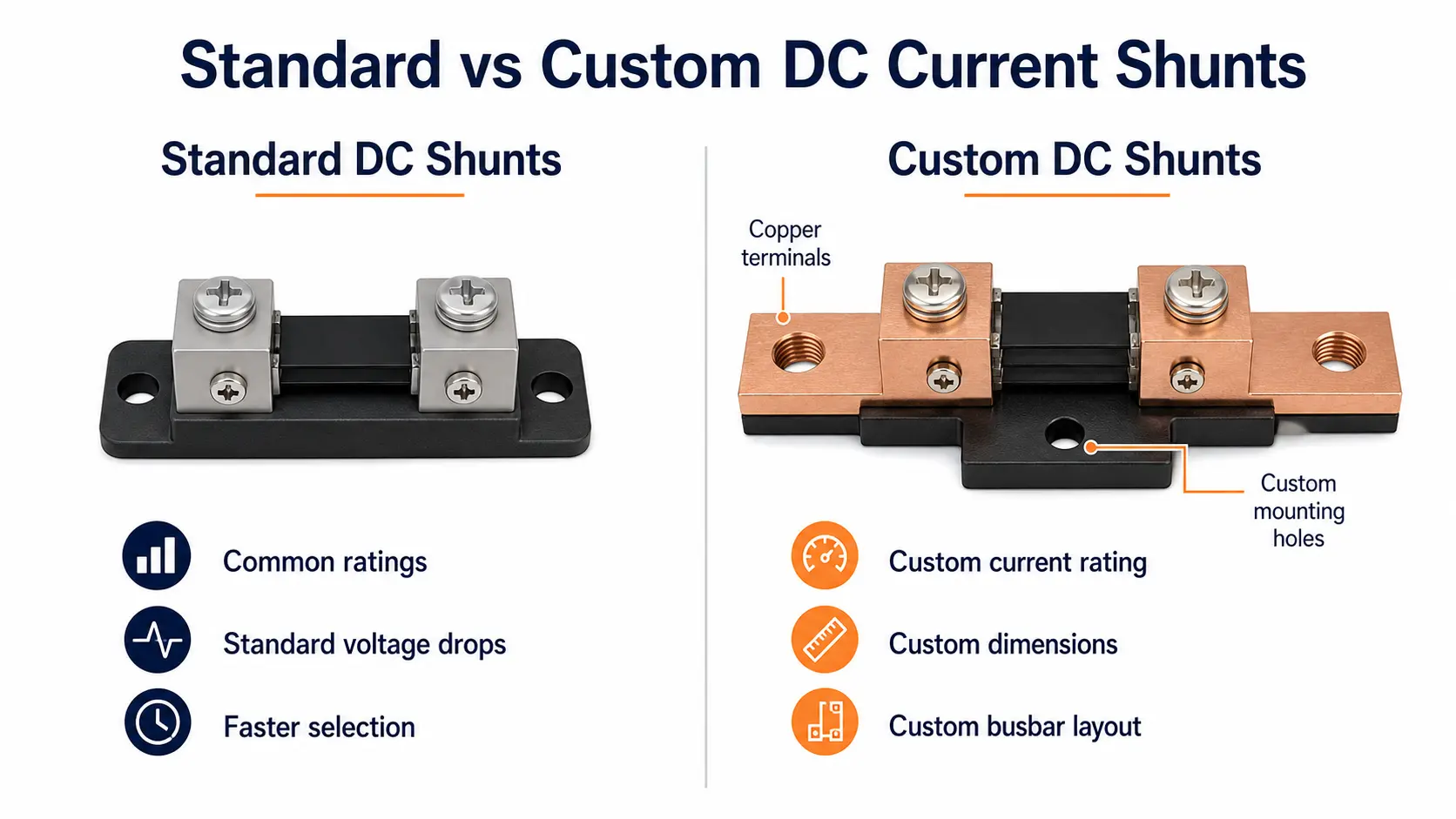
When Do Buyers Need a Custom DC Shunt?
A standard DC shunt is usually suitable when the required current rating, voltage drop, accuracy, and mounting dimensions already match a catalog model. A custom DC shunt becomes more useful when the equipment has a special electrical requirement or a mechanical layout that a standard product cannot fit.
| Requirement | Standard DC Shunt | Custom DC Shunt |
|---|---|---|
| Common current and mV rating | Usually suitable | Optional |
| Special busbar direction | May not fit | Recommended |
| Limited cabinet or panel space | Check dimensions first | Often required |
| OEM mounting hole position | May need adapter work | Recommended |
| Replacement for an existing sample | Suitable if dimensions match | Recommended when structure differs |
| Non-standard mV output | Limited availability | Recommended |
For available standard models and product families, review the LEEYD DC current shunt product series.
1. Confirm the Current Rating and Current Profile
The rated current should be stated clearly, but buyers should also explain how the current behaves in the real system. A shunt used for continuous battery discharge is not reviewed the same way as a shunt used for welding pulses or test equipment peaks.
| Current Detail | What to Provide | Why It Matters |
|---|---|---|
| Rated current | Example: 100A, 500A, 1000A, 5000A | Defines the full-scale current range |
| Continuous current | Normal current during long operation | Affects heating and long-term stability |
| Peak current | Peak value and duration | Supports overload review |
| Duty cycle | On-time, rest time, and repeat pattern | Shows how heat accumulates |
| Application | Welding, battery, EV, switchgear, test equipment | Helps the supplier understand the operating environment |
2. Match the Millivolt Output to the Meter or Controller
A DC shunt should be specified as a current and voltage-drop pair, such as 500A/75mV or 1000A/50mV. The millivolt output must match the meter, controller, PLC input, battery monitor, or test instrument that reads the signal.
Common outputs include 40mV, 50mV, 60mV, 75mV, 100mV, and custom values. If the instrument is fixed at 75mV, the custom shunt should normally use the same full-scale output. If the instrument can be configured, confirm the accepted input range and scaling method before ordering.
For more detail on this point, see the 75mV shunt guide.
3. Define Accuracy and Validation Conditions
Accuracy should be tied to the measurement function. A panel display, a protection circuit, a battery monitoring system, and a calibration bench may require different tolerance levels. Tell the supplier whether the shunt is used for indication, feedback control, protection, energy monitoring, or testing.
Also confirm how the sample will be checked. If your team requires output testing at a certain current, dimensional inspection, material confirmation, or test records, define those requirements before production. This helps avoid approval delays after samples arrive.
4. Check Heat, Duty Cycle, and Installation Environment
A custom DC shunt carries the main current, so heat must be considered. High current, limited airflow, enclosed cabinets, nearby heat sources, and repeated overload can all affect the shunt temperature and measurement stability.
Before ordering, provide ambient temperature, enclosure information, airflow condition, mounting direction, expected current profile, and whether the shunt connects to large busbars or cables. For the basic current-to-millivolt principle, see how a DC current shunt works.
5. Confirm Dimensions, Mounting Holes, and Busbar Layout
Mechanical fit is one of the main reasons buyers request custom DC shunts. The electrical rating may be correct, but the shunt still cannot be installed if the hole spacing, terminal direction, busbar thickness, or available space is wrong.
Provide a drawing whenever possible. If a drawing is not available, send clear photos, key dimensions, hole positions, terminal details, and the installation space. For replacement projects, send photos of the existing shunt label and the surrounding connection structure.
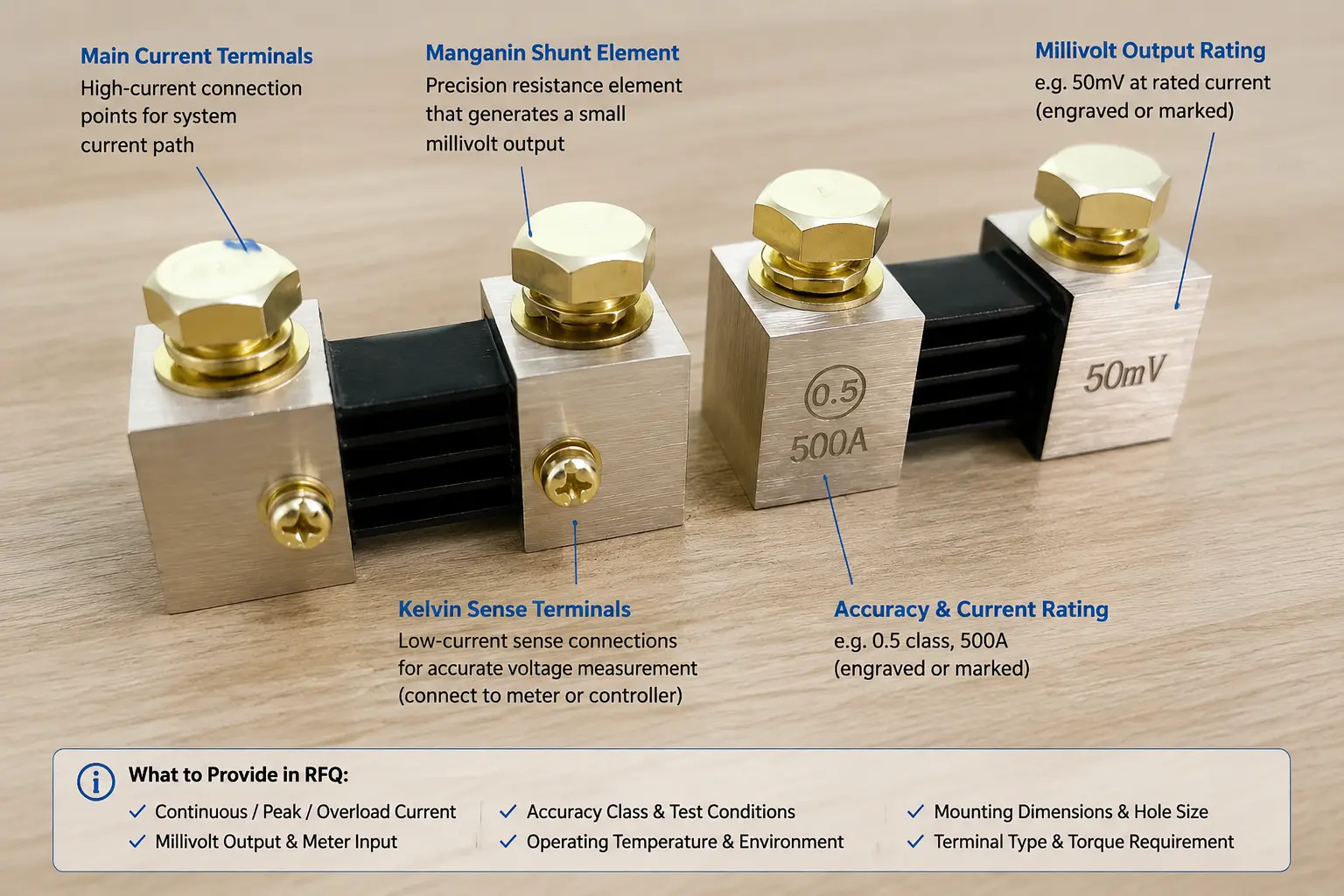
6. Separate Current Terminals From Sense Terminals
Many industrial DC shunts use separate current terminals and sense terminals. The current terminals carry the main load current. The sense terminals provide the millivolt signal to the instrument. A custom design should preserve this measurement structure so the meter reads the calibrated shunt element, not extra voltage drop from bolts, lugs, or busbars.
If your equipment has a special wiring direction or limited space for sense leads, include that in the drawing. For installation details, read the DC shunt wiring diagram guide.
7. Decide Whether You Need a Drawing-Based or Sample-Based Custom Shunt
Some custom projects start from a formal drawing. Others start from a physical sample that needs to be replaced or adapted. Both can work, but the required information is different.
| Project Type | Best Starting Point | Information Needed |
|---|---|---|
| New OEM design | Drawing and electrical specification | Current rating, mV output, accuracy, dimensions, terminals, busbar layout |
| Replacement part | Existing sample and photos | Label, dimensions, mounting holes, terminal material, application, current rating |
| Standard model adaptation | Catalog model plus modification notes | Which dimensions, holes, or terminals need to change |
| High-current custom system | Electrical and mechanical review | Current profile, heat condition, connection method, validation plan |
Custom DC Shunt Ordering Checklist
| Item | What Buyers Should Confirm |
|---|---|
| Product type | Custom DC shunt, standard model modification, or replacement sample |
| Current rating | Rated, continuous, peak, and overload current |
| Voltage drop | 40mV, 50mV, 60mV, 75mV, 100mV, or custom |
| Accuracy | Required class, tolerance, or test condition |
| Application | Welding, battery, EV, energy storage, switchgear, industrial power, test equipment |
| Mechanical design | Drawing, dimensions, mounting holes, busbar direction, terminal material |
| Connection method | Current terminals, sense terminals, cable lugs, busbars, screw size |
| Operating condition | Duty cycle, ambient temperature, airflow, enclosure, vibration, nearby heat |
| Validation | Sample test method, inspection record, acceptance criteria |
| Commercial details | Sample quantity, production quantity, target delivery time, packaging needs |
How LEEYD Supports Custom DC Shunt Projects
LEEYD manufactures standard and custom DC current shunts for accurate current measurement in welding equipment, battery systems, EV and energy storage applications, switchgear, industrial power systems, and test equipment. Custom options can include current rating, voltage drop, accuracy, dimensions, mounting holes, terminal material, and busbar layout.
If your project is still in the selection stage, start from the DC current shunt selection guide. If you are ready to prepare a quotation request, use the Custom DC Shunt RFQ Checklist before sending the final details.
Frequently Asked Questions
What is a custom DC shunt?
A custom DC shunt is a current-measurement shunt made to match a specific current rating, voltage drop, accuracy, dimensions, terminal material, mounting hole position, or busbar layout.
When should I choose a custom shunt instead of a standard model?
Choose a custom shunt when a standard model cannot fit the electrical rating, meter input, cabinet space, terminal direction, busbar layout, or OEM mounting requirements.
Is rated current enough for a custom DC shunt order?
No. Buyers should also confirm the mV output, accuracy, duty cycle, heat conditions, dimensions, mounting holes, terminal material, wiring method, and validation requirements.
Can LEEYD make a custom shunt from a sample?
Yes, a sample can help when a drawing is not available. Buyers should still provide key electrical specifications, dimensions, application details, and photos of the installed part when possible.
What files should I send for a custom DC shunt quotation?
Send a drawing or sample photos, current rating, mV output, accuracy requirement, dimensions, terminal layout, application, duty cycle, sample quantity, production quantity, and target delivery time.
Need a custom DC shunt for your equipment? Send your current rating, mV output, drawing or sample photos, mounting space, and application requirements to LEEYD for model review or custom design support.